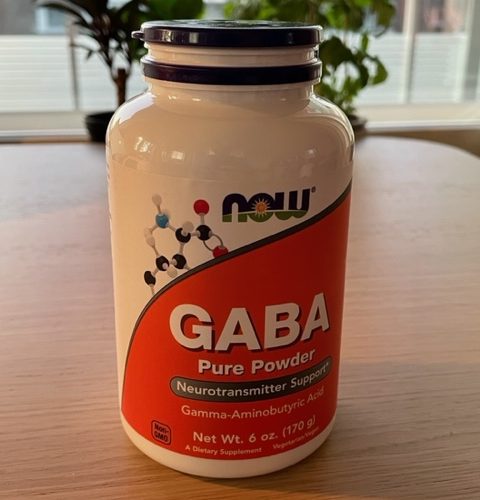
Short answer: oral GABA is biologically interesting, but the evidence is much weaker than supplement marketing suggests. A systematic review found limited evidence for stress reduction and very limited evidence for sleep benefits. Small trials suggest oral GABA can alter growth-hormone responses, and newer small studies have explored body composition, but there is not good evidence that GABA is a stand-alone fat-loss supplement or that it prevents exercise ‘hypoxia.’ My own positive workout experience is therefore best treated as an observation to explain, not as proof of mechanism.
What GABA is
Gamma-aminobutyric acid (GABA) is the main inhibitory neurotransmitter in the mammalian central nervous system. That fact is well established. A different question is whether swallowed GABA supplements reproduce meaningful central effects, because orally consumed GABA has uncertain and probably limited access across the blood-brain barrier.
This distinction matters. ‘GABA is important in the brain’ does not automatically imply that more oral GABA will produce the same effect as increasing GABAergic signaling inside the brain.
Does oral GABA help with stress or sleep?
A 2020 systematic review examined 14 placebo-controlled human studies of natural or biosynthetic oral GABA. The authors found limited evidence for stress benefits and very limited evidence for sleep benefits, with substantial variation in dose, study design and outcome measures. That is a much more cautious conclusion than ‘GABA definitely improves sleep.’ PubMed: systematic review of oral GABA for stress and sleep.
Does GABA increase growth hormone?
There is a real human signal here, although the studies are small. In a 2008 study, oral GABA increased measured growth-hormone concentrations at rest and after resistance exercise. The important limitation is that a transient rise in circulating growth hormone is not the same thing as proven gains in muscle or loss of body fat. The authors explicitly noted that the relevance to training adaptations was unknown. PubMed: growth hormone isoform responses to GABA ingestion.
A later 12-week trial in 21 men compared whey protein with whey plus 100 mg GABA during resistance training. The GABA group showed a greater increase in whole-body fat-free mass, but the study was tiny and several authors worked for the company that supplied GABA. It is therefore an interesting signal, not a definitive answer. PubMed: GABA plus whey protein and resistance training.
Does GABA help with weight loss?
There is no strong evidence that GABA by itself is a weight-loss supplement. A small 2025 randomized double-blind trial studied 26 women with obesity who received 200 mg GABA or placebo while both groups performed exercise training for 12 weeks. The GABA group reduced BMI and waist circumference and appeared to preserve body composition differently from placebo, but the sample was too small to establish a general fat-loss effect. PubMed: GABA plus exercise in women with obesity.
So if the question is ‘does GABA cause weight loss?’, the evidence-based answer is: not established. The interesting research question is whether GABA modifies stress, sleep, appetite, endocrine responses or training adaptation in ways that can indirectly affect body composition.
My workout observation
I originally wrote this article because I noticed a reproducible subjective effect when I used GABA around training: less yawning and post-exercise exhaustion, and better sleep. I interpreted this at the time as reduced hypoxia and improved glucose utilization. I can no longer justify that mechanism from the available human evidence. Yawning or fatigue during a hard workout is not a specific measure of tissue hypoxia, and I was not measuring oxygen saturation, blood gases, lactate, glucose or cerebral blood flow.
The observation itself remains useful. The honest formulation is: I experienced a noticeable change after taking GABA, but I do not know the mechanism. Possible explanations include a real peripheral or neuroendocrine effect, altered arousal, expectancy, changes in another component of the workout drink, or normal day-to-day variation. A blinded self-experiment would be a better way to separate those possibilities.
What the blood-brain barrier question really means
The common objection to oral GABA is that it does not readily cross the blood-brain barrier. That does not prove oral GABA is inert. Peripheral GABA receptors, the enteric nervous system, endocrine signaling and small or variable central penetration are all possible routes worth studying. But it does mean that claims about ‘directly calming the brain’ need stronger evidence than the fact that GABA is an inhibitory neurotransmitter.
Bottom line
Oral GABA is not nonsense, but neither is it a proven all-purpose recovery supplement. Human evidence is strongest for showing that oral GABA can produce measurable physiological effects; evidence for meaningful sleep, stress, fat-loss or performance outcomes remains limited. The most interesting next step is better controlled experimentation, not larger claims.
Medical information
This article may contain published medical evidence, clinical context, personal observations, or hypotheses. These are not equivalent levels of evidence. See the Editorial & Medical Review Policy and Medical Disclaimer. This content is educational and does not provide an individual diagnosis or treatment plan.
I’m taking it for the second time, taking it for sleep and tranquility. It helps, but there are mild side effects in the form of tingling in the head and increased breathing for a short period of time.
As a pharmacist, I am knowing that in theory, this stuff should not crossing the blood brain barrier and having an effect. But from my personal experience, it definitely does something after I am taking it. I am feeling more calm and relaxed.