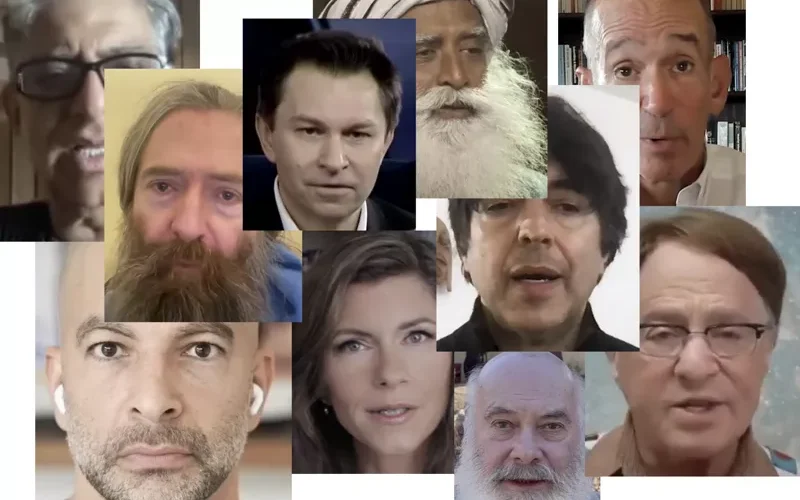
Short answer: I ran screenshots of ten public figures associated with longevity and wellbeing through a facial-age estimator. Some came back strikingly younger than their chronological ages. Yet the numbers describe how one algorithm read particular photographs, not biological age, slower ageing or the effects of anyone’s health routine. The interesting question is what the software saw, and what it missed.
What this experiment can and cannot measure
I began this experiment as an informal comparison of people who write, research or speak about ageing. The photographs and the arithmetic are worth revisiting, but the language matters. Here, the apparent facial-age gap is simply the software’s estimate minus a person’s chronological age. A negative number means that the model judged the face to look younger. It is not a measure of biological age or rejuvenation.
Independent testing provides a useful reality check. In its Face Analysis Technology Evaluation, NIST found that age estimates vary with the algorithm, image quality, age, sex and region of birth, among other factors. Even a change of expression or a pair of glasses can shift the result. In NIST’s 2024 evaluation, the tested systems had a mean absolute error of about 3.1 years on a standardised visa-photo dataset, with differences across demographic groups. That figure does not establish the accuracy of the tool used here.
Reference: National Institute of Standards and Technology, NIST Reports First Results From Age Estimation Software Evaluation, based on NISTIR 8525.
Key Takeaways
- A photograph is not a biological-age test. These results come from one facial-age service applied to selected video screenshots.
- Image conditions matter. Lighting, angles, expressions, facial hair and model bias can influence the estimate.
- The differences can be striking. Some participants received much younger apparent-age estimates, but the results cannot validate their longevity routines.
For these original comparisons, I used the facial-age service ToolPie.
I chose it largely because I could upload photographs from other sources. Its estimates had seemed plausible in my informal trials with acquaintances, but those trials were no substitute for a validation study. I tried to select frontal images with reasonably level head positions. A camera placed above a face, I had noticed, could produce a younger estimate.
Facial-age software learns statistical patterns from photographs labelled with people’s ages, then applies those patterns to a new image. It can recognise visual cues. It cannot tell what is happening in someone’s arteries, cells or organs.
The ten people below emerged from my searches around ageing and longevity. Their order reflects that informal discovery process, not a scientific ranking or a representative sample.
- Aubrey de Grey: A biomedical gerontologist who co-founded the SENS Research Foundation, an organization dedicated to studying and defeating the diseases of aging.
- David Sinclair: A professor at Harvard Medical School known for his work on understanding why we age and how to slow its effects.
- Valter Longo: A biochemist known for his research into aging and life span, particularly his work on fasting.
- Peter Attia: An anti-aging physician who runs a medical practice focused on health, longevity, and preventive medicine.
- Andrew Weil: Known for his work in integrative medicine and his “Anti-Inflammatory Diet”.
- Sara Gottfried: A Harvard-educated MD and author, known for her work on hormonal balance.
- Joseph Mercola: A well-known figure in alternative medicine.
- Ray Kurzweil: A futurist and an AI visionary at Google, known for his claims about the potential for life extension through a combination of supplements, diet, and future advancements in biotechnology.
- Deepak Chopra: A man who believes that one can significantly impact their aging process through a combination of meditation, yoga, and a specific diet.
- Sadhguru (Jagadish Vasudev): A guru who promotes holistic well-being, emphasizing inner transformation and mindfulness practices.
For each screenshot, I subtract the person’s chronological age from the estimate returned by ToolPie. An apparent facial-age gap of −10 means that this particular image was estimated to look ten years younger. Lighting, camera angle, expression, facial hair, cosmetics and image quality can all affect the result, as can bias in the model. The observations belong to the photographs and the tool, not to the biological ageing process.
Take the first Aubrey de Grey screenshot, from 2020: the software returned 44 years against a chronological age of 57. The difference is −13 years. That describes the model’s judgement of the image, not a thirteen-year reduction in his biological age.
1. Aubrey de Grey. Born: April 20, 1963


https://www.youtube.com/watch?v=oWYBdrQPQjM – video from 2020: 44 (determined) – 57 (actual) = -13 years
https://www.youtube.com/watch?v=anyWHDrmZbg – video from 2022: 45 (determined) – 59 (actual) = -14 years
https://www.youtube.com/watch?v=lg9v9ii2Kkk – video from 2023: 50 (determined) – 60 (actual) = -10 years
Average: -12.3 years.
The three estimates place these photographs roughly ten to fourteen years below de Grey’s chronological age. His prominent beard is an obvious complication: it conceals much of the lower face, and we cannot tell how the estimate might change without it.
2. David Sinclair. Born: 26 June, 1969


https://www.youtube.com/watch?v=IEz1P4i1P7s – video from 2019: 40 (determined) – 50 (actual) = -10 years
https://www.youtube.com/watch?v=r2DxoqkGQJI – video from 2022: 39 (determined) – 53 (actual) = -14 years
https://www.youtube.com/watch?v=fsUUgTPtwnc – video from 2023: 39 (determined) – 54 (actual) = -15 years
Average: -13 years (more detailed analysis)
Sinclair’s three screenshots all produce negative gaps, with the later photographs receiving younger estimates relative to his chronological age. That is an intriguing visual pattern, not evidence that ageing has stopped. The images were not taken under standardised conditions, and several years of variation would be unsurprising in an age-estimation system. I examine his images further in a separate analysis.
3. Valter Longo. Born: October 9, 1967


https://www.youtube.com/watch?v=jNI8IlMhg3A – video from 2020: 47 (determined) – 53 (actual) = -6 years
https://www.youtube.com/watch?v=z4GD5cKG1sE – video from 2022: 47 (determined) – 55 (actual) = -8 years
https://www.youtube.com/watch?v=7PdKZPBen0w – video from 2023: 52 (determined) – 56 (actual) = -4 years
Average: -6 years.
Longo’s average gap is smaller than those of several people above. That does not place him behind them in longevity: it tells us only how this model assessed these three images.
4. Peter Attia. Born: 19 March, 1973


Finding suitable photographs of Attia took more searching than expected. He often wears a baseball cap during public appearances, introducing another variable whose effect on these estimates I cannot quantify.
https://www.youtube.com/watch?v=vDFxdkck354 – video from 2017: 35 (determined) – 44 (actual) = -9 years
https://www.youtube.com/watch?v=ExZ9JF69px0 – video from 2021: 44 (determined) – 48 (actual) = -4 years
https://www.youtube.com/watch?v=v8VFTQ74bqo – video from 2023: 51 (determined) – 50 (actual) = +1 year
Average: -4 years.
Across these photographs, the estimate rises from 35 to 51. It would be tempting to read that as accelerated ageing, but the photographs differ in lighting, expression and headwear. Ordinary model error is another explanation. The pattern raises a question; it does not answer one.
5. Andrew Weil. Born: June 8, 1942


https://www.youtube.com/watch?v=SYmb0DYRQKQ – video from 2011: 62 (determined) – 69 (actual) = -7 years
https://www.youtube.com/watch?v=bcSr7hueQOo – video from 2021: 56 (determined) – 79 (actual) = -23 years
https://www.youtube.com/shorts/TlS3OQ7jwaI – video from 2023: 65 (determined) – 81 (actual) = -16 years
Average: -15.3 years.
Weil’s estimates fluctuate markedly between years. The sizeable negative average makes the photographs interesting, but the spread is a reminder that neither camera conditions nor model behaviour were controlled. Nothing here establishes a link with his dietary or medical philosophy.
6. Sara Gottfried. Born: February 23, 1967


Gottfried’s photographs introduce another difficulty: styling, cosmetics and possible image processing can change the cues available to an age-estimation model. Those influences are not unique to women, and the photographs cannot tell us which, if any, were involved here.
https://www.youtube.com/watch?v=BImf6R97UiE – video from 2019: 41 (determined) – 52 (actual) = -11 years
https://www.youtube.com/watch?v=O_DgxuZtgDs – video from 2021: 37 (determined) – 54 (actual) = -17 years
https://www.youtube.com/watch?v=BrFT6N7KaL0 – video from 2023: 34 (determined) – 56 (actual) = -22 years
The gaps are large, but so are the possible sources of error. Lighting, cosmetics, facial expression and image processing may matter; independent NIST testing has also found higher age-estimation errors for female faces in many systems. None of these screenshots establishes biological rejuvenation.
A second video from 2023 gives a noticeably different result: https://www.youtube.com/watch?v=OxzpB-ZZomQ — estimated age 42, chronological age 56, a gap of −14 years (photo).

Average: -16 years.
With that additional 2023 photograph included, the average gap is about −16 years. More revealing than the average is the disagreement between two images from the same year. The model’s judgement can change substantially even when the person and chronological age do not.
7. Joseph Mercola. Born: July 8, 1954


https://www.youtube.com/watch?v=qsRBYKsdshQ – video from 2019: 54 (determined) – 65 (actual) = -11 years
https://www.youtube.com/watch?v=t1e45Rhz0wE – video from 2020: 53 (determined) – 66 (actual) = -13 years
https://www.youtube.com/watch?v=M4QlWWt_lW4 – video from 2023: 63 (determined) – 69 (actual) = -6 years
Average: -10 years.
Mercola’s 2023 estimate is closer to his chronological age than either earlier result. The photographs alone cannot tell us whether his appearance changed, the model responded differently to the image, or both.
8. Ray Kurzweil. Born: February 12, 1948


https://www.youtube.com/watch?v=ybb052CNE3I – 2018: 54 (determined) – 70 (actual) = -16 years
https://www.youtube.com/watch?v=JbKNbMgRbJA – 2021: 58 (determined) – 73 (actual) = -15 years
https://www.youtube.com/watch?v=8SLnP8zikXI – 2023: 59 (determined) – 75 (actual) = -16 years
Average: -15.7 years.
Kurzweil’s three gaps are remarkably similar. That consistency says something about this particular set of images, but not whether his predictions about radical life extension will come true.
9. Deepak Chopra. Born: October 22, 1946


https://www.youtube.com/watch?v=CHmnPVApfFE – 2018: 52 (determined) – 72 (actual) = -20 years
https://www.youtube.com/watch?v=mJp9MwjkTrI – 2020: 51 (determined) – 74 (actual) = -23 years
https://www.youtube.com/watch?v=znV8nSd2odg – 2023: 56 (determined) – 77 (actual) = -21 years
Average: -21.3 years.
Chopra’s three photographs produce consistently large negative gaps. Consistency does not settle the central question: does the model see an unusually youthful face, or does it systematically underestimate age for faces with particular characteristics? NIST’s findings on demographic differences are one reason to resist comparisons between individuals.
10. Sadhguru (Jagadish Vasudev). Born: September 3, 1957


Sadhguru is not primarily known for ageing research, but his emphasis on contemplative practice made him an interesting addition to this informal group. The photographs allow a comparison of appearance estimates, not a test of his teachings.
https://www.youtube.com/watch?v=0vOwBb-w0Qc – 2018: 36 (determined) – 61 (actual) = -25 years
https://www.youtube.com/watch?v=wvIbG6zMbME – 2021: 30 (determined) – 64 (actual) = -34 years
https://www.youtube.com/watch?v=4VkIJKuDyMQ – 2023: 28 (determined) – 66 (actual) = -38 years
Average: -32.2 years.
Here the gap becomes so extreme that the number itself deserves scrutiny. In one 2023 image, the software returned 28 for a person aged 66. Facial hair, skin texture, lighting and demographic effects could each influence that result. Without standardised photographs and independent models, the safest reading is an unusually low estimate, not evidence of rejuvenation.
The photographs leave me with five particularly interesting cases for a closer look, chosen for the variety of their results and public approaches rather than for any proven success or failure:
- David Sinclair: a series of negative gaps across the three years examined.
- Andrew Weil: a large average gap accompanied by striking variation between photographs.
- Peter Attia: a useful contrast, with estimates that rise across the selected images.
- Sara Gottfried: two images from the same year that demonstrate how much the estimate can differ.
- Sadhguru: the most extreme negative gap in this collection; I selected him instead of Deepak Chopra for closer examination.
The infographic gathers these screenshot-based averages in one place. It is a map of the experiment, not a league table of human ageing.
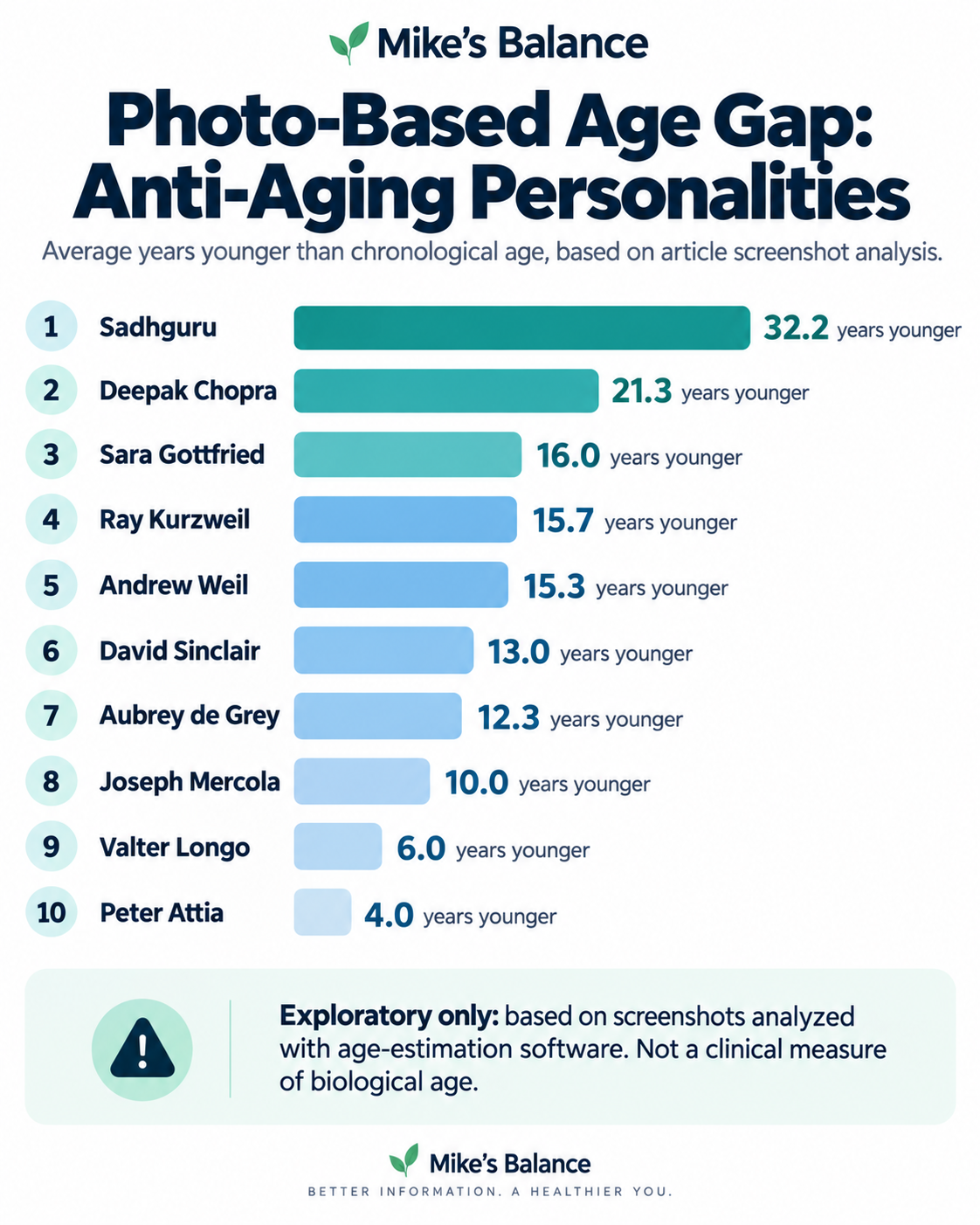
Read the chart as a comparison of one model’s estimates for selected images. The differences do not rank the participants’ health, biological age or prospects of living longer.
The people in these photographs approach ageing from strikingly different directions. What, if anything, can we learn by placing those ideas alongside the facial estimates?
Sinclair studies molecular mechanisms of ageing; Attia concentrates on preventive medicine and physical capacity; Sadhguru approaches wellbeing through contemplative practice. Those distinctions help explain why each person became part of this experiment. They do not make facial-age scores a test of competing philosophies. For more on Sinclair’s reported routine, see this separate review.
Weil, Gottfried and Sadhguru all give considerable attention to everyday habits and psychological wellbeing, though they arrive there through different traditions. Sleep, diet, movement and managing stress recur in their advice. Similar recommendations, however, do not make their broader claims interchangeable or equally well supported.
Gottfried places particular emphasis on hormones and women’s health. Her account combines clinical medicine with diet, exercise, sleep, stress management, mindfulness and, in some instances, genetic testing. That is a description of her approach, not evidence that it explains her photographic results.
Attia has advocated different combinations of strenuous exercise, fasting and low-carbohydrate eating over time. A public routine changes, and it is not a controlled intervention. Nothing in these images establishes whether a particular workout helps or harms longevity.
Weil places more weight on nutrition, lifestyle, meditation and selected natural remedies. These choices reflect a different emphasis from Attia’s fitness-centred approach, but the photographs provide no basis for judging one against the other.
Sadhguru, too, speaks about wellbeing and contemplative practice, although his framework is rooted in Indian spiritual and yogic traditions rather than Western integrative medicine. His views on food are discussed separately here.
Across these very different programmes, six themes recur:
- Cellular biology: Sinclair investigates mechanisms of ageing and possible ways to influence them.
- Whole-person wellbeing: Weil, Gottfried and Sadhguru emphasise habits and psychological experience alongside physical health.
- Hormonal health: Gottfried gives this particular prominence, especially in women’s healthcare.
- Diet and movement: these feature throughout the group, although their preferred regimens differ.
- Mind–body practice: yoga and meditation are central to some approaches and peripheral to others.
- Personal experimentation: notably in Attia’s public discussions, individual routines are tested and revised; that does not make the results controlled evidence.
The experiment ends with a distinction worth keeping. These are observations about how a particular model interpreted particular faces. They are not a ranking of longevity strategies. To investigate whether a smaller facial-age gap reflects slower biological ageing, we would need consistent photography, repeated measurements, independent algorithms and outcomes beyond the photographs themselves. Until then, the most striking results belong to a story about measurement, not immortality.
2026 editorial update: we tested newer AI models
2026 editorial update by Ilya Nikitin (October 2026). This follow-up was not part of the original 2023 experiment.
We revisited the original photographs using two research age-estimation models. On the same image of Sadhguru that ToolPie had rated 28, FaceAge v1 estimated about 73.5 and the newer FAHR-FaceAge about 77.1. Three strikingly different numbers cannot, by themselves, tell us which model is accurate, let alone reveal anyone’s biological age.
Two photographs of Sara Gottfried, both labelled 2023, produced another surprise: FaceAge v1 estimated 39.3 and 56.8, whereas FAHR-FaceAge returned 39.1 and 40.5. The newer model was far more consistent across these two pictures, but consistency is not necessarily accuracy. Gottfried turned 56 in 2023; the images’ actual capture dates have not been independently verified.
In a separate test involving 43 photographs and FaceAge v1, we deliberately shifted each face crop by up to three pixels in 25 combinations. The median range was 3.77 estimated years. This is a sensitivity test, not a typical error margin or confidence interval, and the newer FAHR model uses different image processing. Previous computer-vision research has also shown the importance of face alignment and image handling. The lesson remains simple: a facial-age score is not evidence of slower biological ageing. See the FaceAge and FAHR-Face research projects for the model methods.
Method reference
Hanaoka K, Grother PJ, Ngan ML, Yang J, Quinn GW, Hom A. Face Analysis Technology Evaluation: Age Estimation and Verification. NISTIR 8525, National Institute of Standards and Technology, 2024. NIST continues to update its age-estimation evaluation as new algorithms are submitted.
Which other public figures would make an illuminating comparison? Suggestions are welcome in the comments. And if you have tried a similar experiment with standardised images or several independent models, I would be interested in the method as much as the results.
Don’t you think people use different supplements and creams to prolong youth? Face test error could be ~5 years. But major results definitely amaze.
Yes, determining age from a photograph can yield a margin of error of ± 5 years depending on factors such as the angle, the individual’s state, the time of day, and so forth. That’s why I performed three measurements. Ideally, one should perform even more measurements, take more screenshots, and average the data. It’s a significant amount of work. I might do such a study in a separate article for some of the individuals featured in this piece. Cosmetics and cosmetic procedures also significantly affect the results, which I noted in the article about Sara.
How about testing Liz Parrish?
Will do. But once again, women are more likely to be influenced by cosmetic procedures in determining age based on their face.