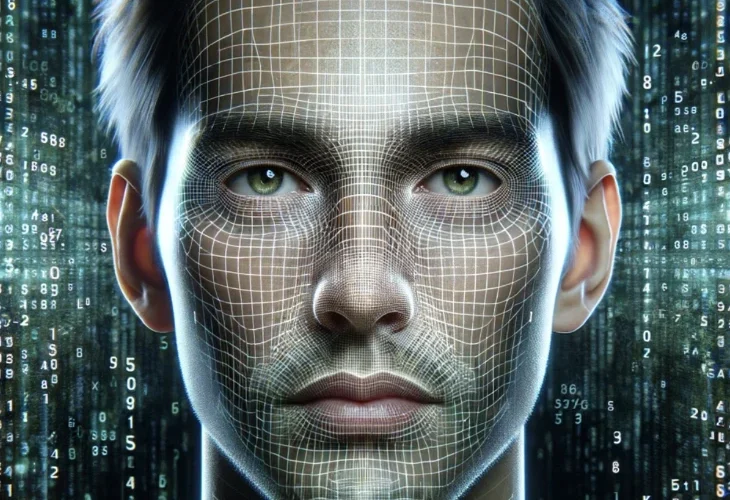
This article revisits an informal experiment in which I compared photographs with online age-estimation tools. The central correction is simple: a numerical estimate of how old someone looks is not a measurement of that person’s biological age.
Biological ageing involves multiple physiological systems. Even molecular ageing biomarkers need careful validation and interpretation. A face-based age estimate, by contrast, is influenced by lighting, facial expression, camera angle, cosmetics, image quality and model training data.
The original experiment used the site age.toolpie.com and an AI assistant. Neither output, on its own, validates biological ageing. It is possible for two tools to agree about the same photograph yet both be inaccurate or biased.
In the screenshots below, I originally asked a language model to assess ‘biological age’ from a picture. That is a question the image cannot answer. The exchange is retained as a record of the earlier experiment, not as an example of reliable clinical measurement.
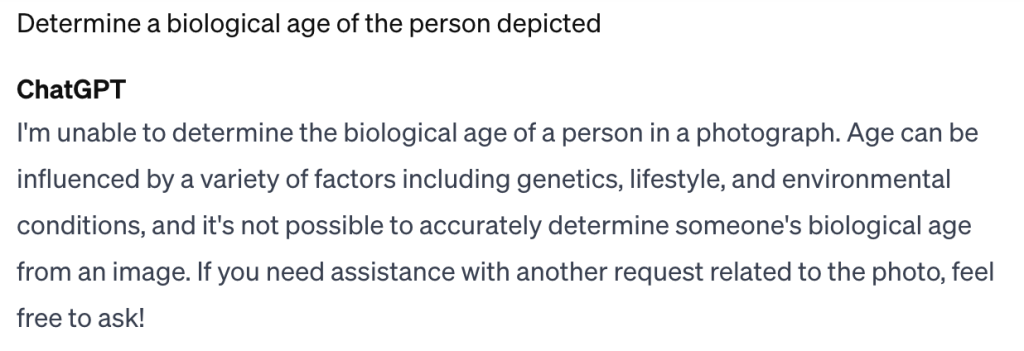
Repeatedly changing a question can alter a model’s reply. The resulting number is sensitive to the conversation and prompt, so it should not be mistaken for an independent second test.
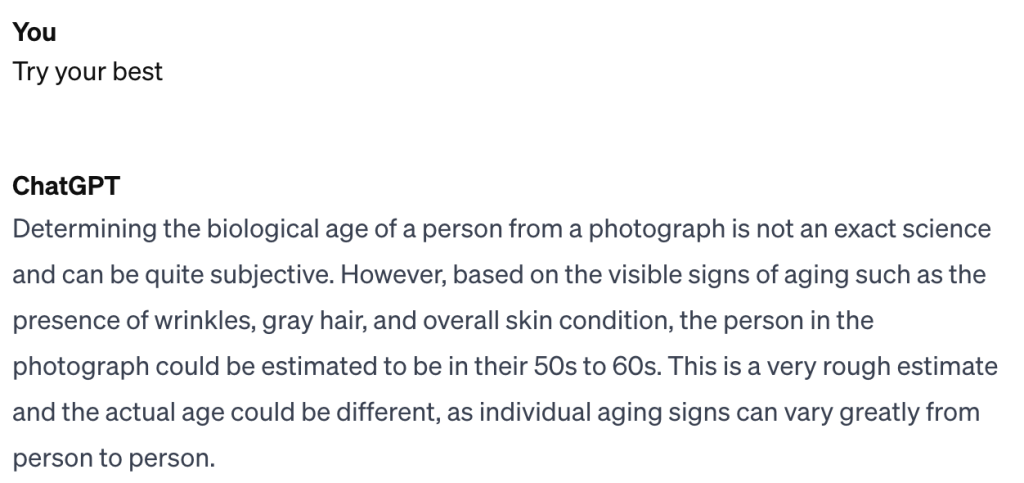
Further prompting can make an answer look more definite without supplying new data or evidence of accuracy.
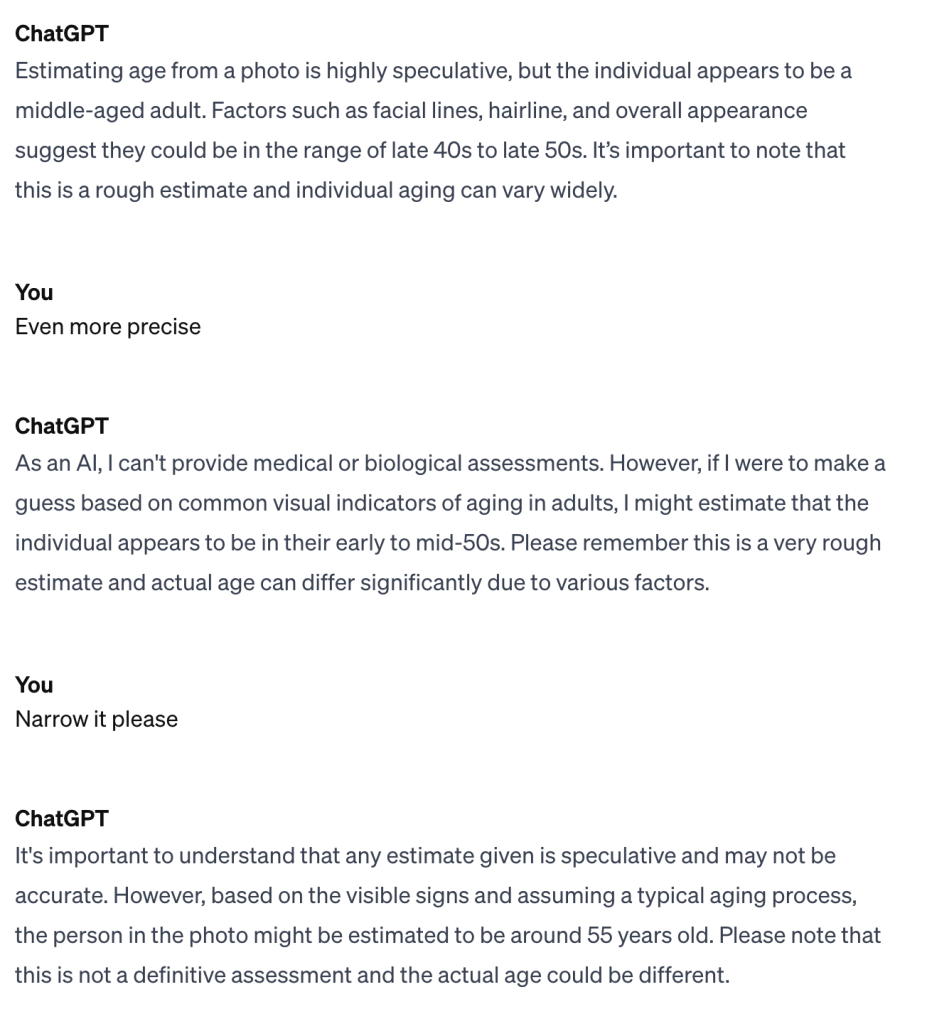
A narrower numerical range is not necessarily greater precision. Without validation on labelled photographs, reliable error estimates and independent replication, the confidence is only apparent.
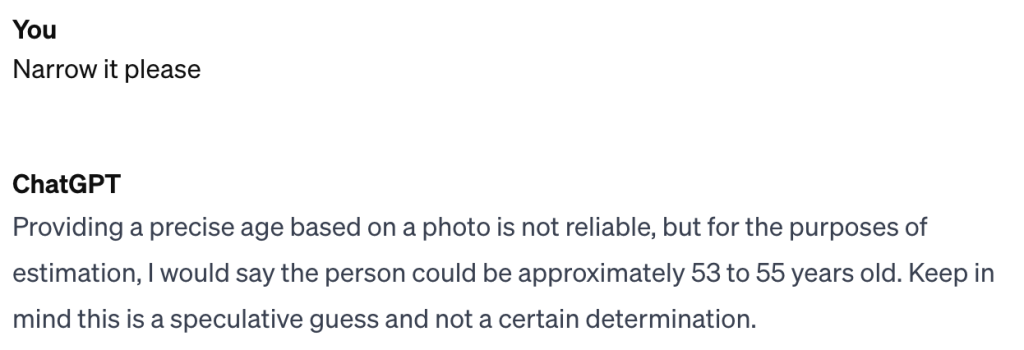
In that conversation, the system eventually suggested an apparent age of roughly 53–55 years. This is an impression derived from one image and an interaction, not a validated biological-age result.
The online tool happened to return 54 years for the same photograph. That agreement is interesting as a comparison of two outputs, but it does not demonstrate that biological age can be determined accurately from photographs. The tools may react to the same visual cues or make similar errors.
I also noticed that apparent-age estimates seemed to change with photographs taken at different times of day. This observation was neither blinded nor standardised, and differences could reflect light, expression, temporary fatigue or image selection rather than changes in the ageing process.
The appropriate conclusion is methodological: age-estimation software may be useful for studying apparent facial age, provided its errors and biases are reported. It cannot diagnose health or measure rejuvenation from a selfie. For a more rigorous discussion, see our facial-age experiment and its limitations and the NIST evaluation of age-estimation algorithms.