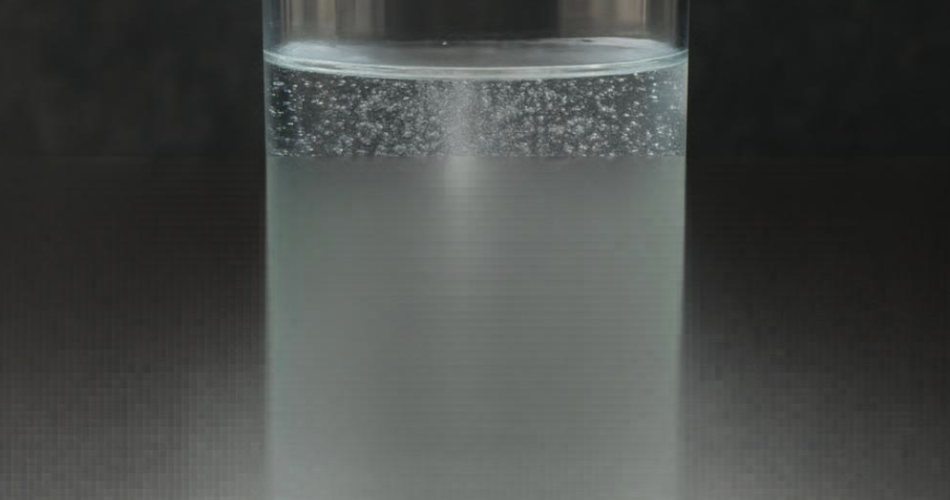
Short answer: I produced strongly negative-ORP water at home using magnesium and zeolite filtration and measured how the reading changed with time and heating. Those measurements are real and reproducible as ORP observations, but they do not by themselves prove the concentration of dissolved molecular hydrogen (H₂). ORP is strongly influenced by pH, temperature and other redox-active compounds. To quantify H₂, a hydrogen-specific method is needed.
My home experiment
My filtration system used three 10SL cartridges: coconut carbon, magnesium + zeolite, and zeolite. Water flowed slowly through the system. Immediately after filtration I measured approximately pH 9.75, ORP −700 mV, TDS 127 ppm, conductivity 260 µS/cm, at about 22°C.
I then followed the ORP over time. My readings were approximately: −700 mV initially, −630 mV after 10 minutes, −575 mV after 30 minutes and −550 mV after one hour. When the water was heated, ORP became progressively less negative: around −500 mV at 44°C, −470 mV at 48°C and later around −410 mV. pH also fell modestly during heating.
What these measurements can tell us
Magnesium metal can generate molecular hydrogen when it reacts with water. Dissolved H₂ can contribute to a negative ORP. So the direction of my measurements is consistent with a system containing a reducing species that is lost or altered over time.
However, a negative ORP is not a hydrogen concentration measurement. A detailed review of electrolyzed-reduced water explains that ORP depends heavily on pH and can change only slightly even when H₂ concentration changes tenfold. The authors specifically discourage using ORP meters to estimate dissolved H₂ concentration. Review: safety and effectiveness of electrolyzed-reduced water as a hydrogen source.
Does ORP prove that water contains molecular hydrogen?
No, not by itself. In alkaline hydrogen-generating systems, a very negative ORP can be compatible with dissolved H₂, but ORP cannot tell you how many mg/L or ppm of H₂ are present. pH, temperature, dissolved oxygen and other redox couples all affect the reading. A second review explains that molecular hydrogen, rather than alkalinity or hypothetical “free electrons,” accounts for the experimentally supported biological effects attributed to electrolyzed-reduced water. Review: molecular hydrogen and electrolyzed-reduced water.
Why heating and standing matter
Hydrogen is a small, poorly soluble gas. Once water is exposed to air, dissolved H₂ can escape. Higher temperature also lowers gas solubility. Therefore it is chemically plausible that freshly prepared hydrogen water loses H₂ with standing and heating. My ORP time series is compatible with that process, but without direct H₂ measurements it cannot separate hydrogen loss from pH and temperature effects.
How to measure hydrogen water properly
- Best: gas chromatography or another validated hydrogen-specific analytical method.
- Practical: a properly calibrated dissolved-hydrogen sensor designed specifically for H₂, not an ORP-to-H₂ conversion algorithm.
- Useful supporting measurements: pH, temperature, ORP, dissolved oxygen, conductivity and time since production.
My conclusion
The most defensible conclusion from my experiment is narrower than my original wording: the magnesium-based system produced highly reducing, alkaline water whose ORP became less negative with time and heating. Molecular hydrogen is a plausible contributor, but the amount of dissolved H₂ was not directly measured. That distinction makes the experiment more useful, because another person can now reproduce the setup and add a hydrogen-specific measurement.