
A magnesium supplement promises a quieter night. The label offers a choice of forms, each with a different story about absorption, relaxation or the brain. Yet clinical trials have struggled to answer the question that matters: will taking extra magnesium actually help someone sleep?
Some people report sleeping better. A few randomized trials find small improvements. Others find no advantage over a placebo. The overlooked difficulty is not simply the type of magnesium. In several influential trials, investigators did not establish whether participants had adequate magnesium status before giving them more.
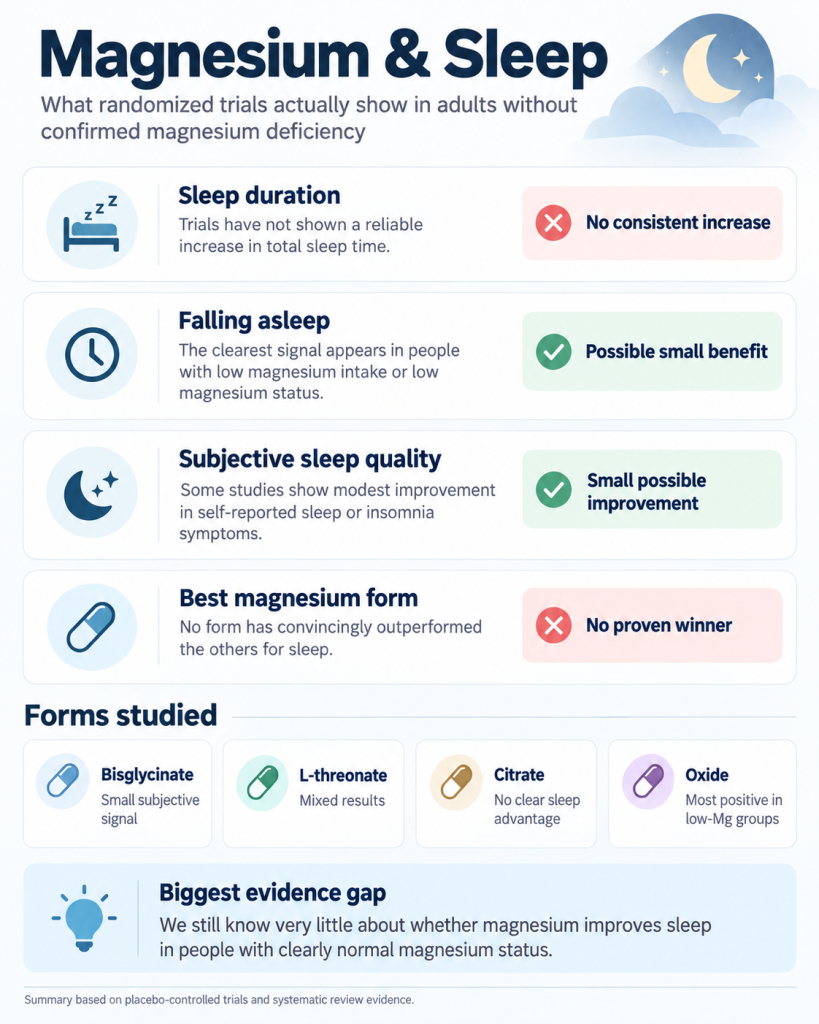
The short answer: A small improvement in some self-reported sleep outcomes is possible, but results are inconsistent and the overall certainty of evidence is low or very low. Magnesium has not been shown to reliably extend sleep, no form is proven superior, and routine supplementation is not an evidence-based treatment for insomnia.
The 2026 review: more trials, still no reliable sleep remedy
On 28 August 2026, a systematic review in the Journal of Dietary Supplements brought together randomized controlled trials of oral magnesium used on its own for sleep-related outcomes. It included 12 trials in its main sleep and insomnia analysis, plus three additional trials involving conditions such as restless legs or night cramps, analysed separately. The authors searched databases and trial registries through 1 June 2026, evaluated study bias and used GRADE to judge confidence in the evidence.
Their conclusion was restrained: findings varied across questionnaires, sleep laboratory measurements, research-grade activity monitors and consumer wearables. Certainty was rated low to very low. There was insufficient evidence to recommend magnesium routinely for insomnia, identify a best form or dose, or say which patients might benefit most.
This is more informative than the earlier 2021 meta-analysis, which included only three placebo-controlled trials with 151 older adults. The newer review also matters for our central question: it explicitly found that the existing trials have not established a greater sleep benefit among people with low magnesium intake or status. That remains a research hypothesis, not a clinical finding.
An important disclosure: two review authors were investigators in trials included in the review. The paper reports that its third author independently checked extraction, bias assessments and GRADE contributions for those trials. The declared relationships deserve attention without automatically disqualifying the review.
The number that changes the story: 3.9 versus 2.3
Consider one of the better recent experiments. In a 2025 randomized trial, 155 adults reporting poor sleep were assigned to magnesium bisglycinate or placebo for four weeks. The supplement delivered 250 mg of elemental magnesium daily. Researchers used the Insomnia Severity Index (ISI), a validated questionnaire on sleep difficulties and their daytime consequences.
The average estimated ISI score improved by 3.9 points in the magnesium group. Impressive? Only until we look at the other half of the experiment. The placebo group improved by 2.3 points. The difference in improvement was approximately 1.6 points, with a small standardised effect (Cohen’s d = 0.20; p = 0.049). A separate sleep-quality questionnaire did not show a statistically significant between-group difference (p = 0.069).
Net difference ≈ 1.6 ISI points. These bars show within-group improvement, not absolute scores or the probability of an individual responding. The horizontal scale is identical for both bars (0 to 4.5 points). Source: Schuster et al., 2025.
It is tempting to read the 3.9-point change as the magnesium effect. That would be a mistake. In a placebo-controlled trial, the informative comparison is between the groups. Participants can improve for many reasons: natural fluctuation, expectations, changes in routine or simply the passage of time.
A reduction of six ISI points is one commonly used threshold for a clinically meaningful improvement within a person. It is not a threshold that can be mechanically compared with the 1.6-point difference between group averages. Both numbers matter, but they answer different questions. The trial’s main result suggests a modest average benefit, not an extra hour of sleep or a dramatic reversal of insomnia.
There is another complication. The bisglycinate preparation also supplied around 1.5 g of glycine daily. The study tested the whole supplement, not isolated magnesium ions, and it did not measure baseline biochemical magnesium status. An exploratory analysis suggested greater improvement among people reporting lower dietary magnesium intake, but this does not establish that a confirmed deficiency caused the response.
The missing measurement: who needed more magnesium?
Imagine testing an iron supplement for fatigue without checking whether participants were iron-deficient. A negative average result would not prove the supplement never helps; a positive result would not tell us who needed it. Magnesium trials face a related, though biologically more complicated, problem.
Three claims are easily confused. Low reported intake means a dietary questionnaire suggests a person eats less magnesium than recommended. Low serum magnesium means the concentration in blood falls below a specified laboratory threshold. Magnesium deficiency is a clinical judgement that cannot always be reduced to either measure alone. The distinctions are essential.
In the often-cited 2012 magnesium-oxide trial, investigators enrolled 46 older people with insomnia, dietary magnesium intake below 75% of the recommended level and serum magnesium below 0.95 mmol/L. Some subjective sleep outcomes improved, while total sleep time did not significantly differ between groups. Yet the 0.95 mmol/L eligibility cut-off should not be described as proof that all participants were clinically deficient: it is higher than the commonly used threshold for hypomagnesemia, approximately 0.75 mmol/L, described by the NIH Office of Dietary Supplements.
The trial is consistent with the possibility that inadequate intake matters. It cannot prove that magnesium works because intake is low, since it did not demonstrate a treatment-effect difference between reliably classified deficient and replete groups. Nor can it tell us what would happen in adults whose intake and magnesium status were demonstrably adequate.
Evidence map: what the trials knew before treatment
| Trial | Adults | Baseline magnesium assessment | Sleep signal |
|---|---|---|---|
| Bisglycinate, 2025 | 155 | Dietary intake analysed; baseline magnesium biomarkers not measured | Small ISI advantage over placebo; no clear gain on a separate sleep-quality scale |
| L-threonate, 2026 | 100 | Biochemical baseline status not reported as measured | Sleep-related daytime impairment improved; Oura-derived sleep outcomes did not differ |
| Citrate, 2010 | 100 in paper | Serum magnesium assessed, including a lower-serum subgroup | Overall sleep-quality improvement was not magnesium-specific |
| Oxide, 2012 | 46 | Low reported intake and serum magnesium < 0.95 mmol/L required for entry | Some insomnia outcomes improved; total sleep time did not |
| Oxide, 2002 | 12 | Not established as a trial of confirmed magnesium-replete adults | Small EEG slow-wave sleep signal; no demonstrated total-sleep gain |
The map makes one point visible: we cannot yet identify a proven “best responder” population. Trials differ not only in formulation and dose, but in whether investigators measured a plausible effect modifier before treatment. A study without baseline biomarkers is not necessarily a poor study. It simply cannot answer a biochemical subgroup question that it was not designed to test.
Why a blood test is not a perfect solution
Serum magnesium is clinically useful, particularly for detecting significant abnormalities, but it reflects less than 1% of total-body magnesium. Concentrations are regulated and a normal result does not rule out all forms of inadequate magnesium availability. Dietary assessment, urinary measures and other biomarkers also have limitations.
The research answer is not to invent a single perfect test. It is to assess intake and relevant biochemical measures before randomisation, define groups in advance, then test whether the supplement works differently across those groups. Until such an interaction is shown, “magnesium helps only if you are deficient” is no more established than “magnesium helps everybody”.
Glycinate, L-threonate, citrate or oxide: what survives comparison?
Bisglycinate: a small signal, not a winner
The 2025 four-week trial offers a credible, if modest, improvement in self-reported insomnia symptoms. It cannot separate magnesium from accompanying glycine, establish long-term benefit or demonstrate superiority over other forms. The magnitude matters more than its narrow statistical significance.
L-threonate: an attractive mechanism, mixed outcomes
Magnesium L-threonate is marketed using a biological story about nervous-system availability. In a six-week randomized study of 100 adults, 2 g of Magtein supplied 145 mg of elemental magnesium daily. Sleep-related daytime impairment improved, but sleep disturbance, restorative sleep and Oura Ring-derived sleep measures showed no significant between-group advantage. The study had manufacturer involvement, which merits disclosure in interpreting product-specific evidence.
A separate 21-day L-threonate trial involving 80 adults reported several positive outcomes. Its differing endpoints and the limitations of effect-size reporting make it hard to combine cleanly with the 100-person study. Mechanistic plausibility cannot fill that evidential gap.
Citrate: both groups slept better
In Nielsen and colleagues’ 2010 trial, participants receiving magnesium citrate and those given sodium citrate placebo improved on overall sleep quality. That is a useful reminder that improvement afterfrom
There is also a reporting discrepancy worth preserving. The journal paper describes 100 participants, 320 mg a day and a seven-week supplementation schedule; the registry entry describes 111 randomized participants, 300 mg a day and a different schedule. We have not found an explanation that warrants silently reconciling those records.
Oxide: older results, limited generalisability
The 2012 trial enrolled people with lower reported intake and a serum-magnesium eligibility threshold, making it particularly relevant to the insufficiency hypothesis. An even smaller 2002 crossover trial of 12 older adults found a change in laboratory-measured slow-wave sleep, but not a convincing increase in total sleep time. Neither study makes oxide the best supplement for sleep.
Most importantly, the August 2026 systematic review found no eligible direct head-to-head trial establishing that one magnesium form improves sleep more than another. Better absorption, a proprietary brain-delivery claim and better clinical sleep are three separate propositions.
Feeling better is not the same as sleeping longer
A person may feel less troubled by sleep while total sleep duration changes little. That improvement can still matter. But a questionnaire score, a wearable estimate and polysomnography do not measure identical things. A claim about lower insomnia distress cannot simply be rewritten as “more deep sleep”.
Across the available trials, positive signals appear more often in selected self-reported outcomes than in consistent objective increases in sleep duration. That does not mean the experiences are imaginary. It means the evidence supports a narrower claim than the marketing typically makes.
The experiment that could actually settle the missing question
A more decisive trial would enrol enough participants with poor sleep to detect a clinically useful effect, record baseline dietary magnesium intake and biochemical status, and specify in advance how low-status and apparently adequate-status groups are defined. Participants would then be randomly assigned to magnesium or placebo, ideally long enough to assess persistence of benefit.
It would measure a validated insomnia scale andtreatment-by-baseline-status interaction. Merely finding a significant result in one subgroup and a nonsignificant result in another would not be enough: the difference between the two treatment effects must itself be tested.
That study could tell us whether low intake or status predicts response. It might also find no interaction at all. Both results would be scientifically useful.
Should you take magnesium to sleep better?
If your diet supplies too little magnesium, addressing that shortfall makes sense for general nutrition. Foods such as legumes, nuts, seeds and whole grains supply magnesium alongside other nutrients. A person with a suspected deficiency, relevant medication use or clinical risk factors may need an individual assessment. None of this establishes that taking extra magnesium will cure insomnia.
For an otherwise healthy adult with adequate intake, current trials offer no reliable expectation of longer or substantially better sleep. A supplement may produce a small subjective improvement for some people, but we cannot predict in advance who those people are. No particular form, dose or timing has emerged as a proven sleep treatment.
For persistent chronic insomnia, the comparison should not be magnesium versus doing nothing. Clinical guidelines from the American College of Physicians and the American Academy of Sleep Medicine recommend cognitive behavioural therapy for insomnia (CBT-I) as a first-line treatment. Sleep habits and exposures such as late-day caffeine also deserve attention, although they are not substitutes for assessment when insomnia persists.
Safety, elemental dose and interactions
The amount of elemental magnesium on the label is more useful than the weight of the whole magnesium compound. The US NIH lists an adult tolerable upper intake level of 350 mg a day from supplemental and medication sources; it does not include naturally occurring magnesium in food. Some research doses exceeded this level under study conditions. They should not be copied as everyday self-treatment.
Supplements can cause diarrhoea, nausea and abdominal cramps. Impaired kidney function increases the risk of magnesium accumulation. Magnesium can interfere with absorption of certain antibiotics and osteoporosis medicines; proton-pump inhibitors and diuretics can also affect magnesium status. Ask a qualified clinician or pharmacist about supplements if these factors apply.
The bottom line
Magnesium is essential to human biology. That fact alone does not make an extra dose a sleep medicine. The strongest available synthesis, published in August 2026, finds inconsistent benefits and low or very low confidence in the trial evidence. A small subjective benefit remains possible, but no form has proved superior and extra sleep time has not been demonstrated reliably.
The question worth carrying into the next generation of studies is not just which magnesium salt to test. It is whether the trial can establish who had room to benefit before the first capsule was given. Until then, the most rigorous answer is both useful and incomplete: magnesium may help some people feel they sleep better, but we do not yet know which people, or by how much.
Frequently asked questions
Does magnesium help you fall asleep faster?
Some small trials suggest a benefit, but results are inconsistent and the certainty of evidence is low or very low. There is no reliable effect established in adults confirmed to have adequate magnesium status.
Which magnesium is best for sleep, glycinate or citrate?
Neither has been proved superior. A bisglycinate trial found a small improvement in insomnia scores; a major citrate trial did not show better overall sleep quality than placebo. No eligible direct comparison establishes a winner.
Is magnesium L-threonate better for sleep?
Not established. Some subjective outcomes improved in trials, but a six-week study found no clear benefit on Oura-derived sleep measures. The proposed mechanism is not evidence of superior clinical results.
Does magnesium only help people who are deficient?
We do not know. Low intake may plausibly modify response, but studies have not shown a reliable interaction between confirmed baseline magnesium status and the effect of supplementation. Low intake, low serum magnesium and clinical deficiency are not interchangeable labels.
Does magnesium increase deep sleep or total sleep time?
Small studies have reported selected changes in sleep architecture, but trials have not consistently demonstrated longer total sleep time or a reproducible objective improvement in deep sleep.
How we reviewed the evidence
Updated 10 October 2026. This is an editorial evidence analysis, not a new systematic review or independent meta-analysis. We use the August 2026 systematic review as the broad evidence base and examine selected placebo-controlled trials, their original reports and a registry entry to explain effect size, baseline-status assessment, subjective versus objective outcomes, doses and limitations. The five-study evidence map is illustrative; it does not represent all 15 studies in the 2026 review.
We distinguish confirmed findings from hypotheses and retain the unexplained difference between the Nielsen paper and trial registry. For patients with chronic insomnia, this overview is educational, not a diagnosis or individualized treatment plan. Significant daytime sleepiness, suspected sleep apnoea, medication-related problems or persistent insomnia merit clinical assessment.
References and source documents
7. ClinicalTrials.gov. Magnesium Nutrition and Sleep Behavior in Older Adults (NCT00833092).
11. NIH Office of Dietary Supplements. Magnesium: Fact Sheet for Health Professionals.