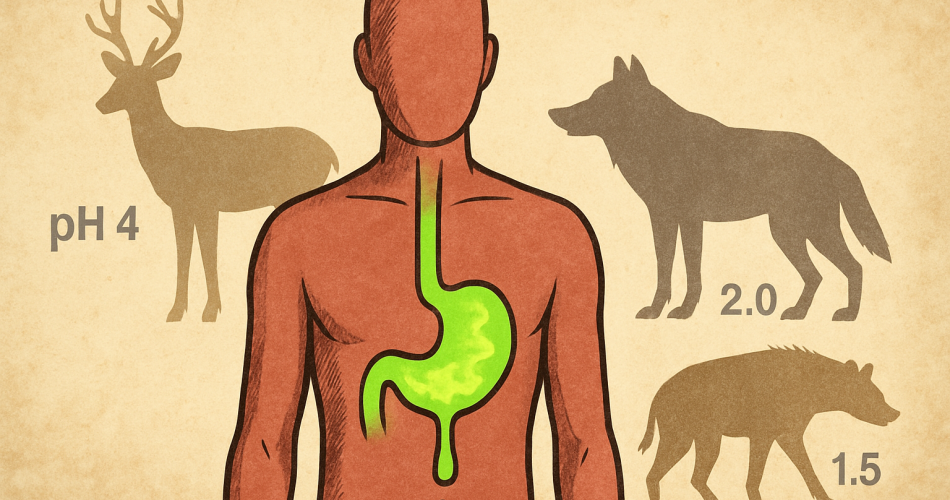
Short answer: the human stomach is unusually acidic. In a comparative dataset spanning birds and mammals, humans were listed at about pH 1.5, close to the range seen in obligate scavengers and more acidic than typical omnivores or herbivores. The strongest interpretation is that gastric acid acts as a microbial filter. That finding is compatible with evolutionary exposure to pathogen-rich foods, including meat and carrion, but stomach pH alone cannot tell us whether ancestral humans were primarily carnivorous, omnivorous, or plant-based.
What the comparative data actually show
A frequently cited comparative analysis by Beasley and colleagues examined published stomach-acidity measurements across 68 species. The pattern was striking: species exposed to more food-borne pathogens tended to have more acidic stomachs. Obligate scavengers had the lowest average pH, followed by facultative scavengers and carnivores, while herbivores generally had much less acidic stomach contents.
Humans stood out. The study’s compiled value for the human stomach was approximately pH 1.5. That is unusually acidic for a primate and falls in the same broad range as some scavenging species. The authors explicitly discussed carrion feeding as one possible explanation, while also noting that strong acidity could reflect pathogen exposure more generally rather than any single food category.
Source: Beasley DE, Koltz AM, Lambert JE, Fierer N, Dunn RR. The Evolution of Stomach Acidity and Its Relevance to the Human Microbiome. PLoS ONE. 2015;10(7):e0134116.
Why would evolution favor such strong acid?
The key comparison is less about a carnivore-versus-herbivore label and more about what gastric acidity can legitimately tell us:
| Observation | What the evidence supports | What it does not prove |
|---|---|---|
| Human gastric pH | About pH 1.5 in the comparative dataset used in the article. | That every person has a fixed pH of 1.5 at all times. |
| Cross-species pattern | Species with greater exposure to food-borne pathogens tended to have more acidic stomachs; obligate scavengers were among the most acidic. | That acidity alone classifies a species as carnivore, omnivore or herbivore. |
| Evolutionary interpretation | Strong gastric acid is plausibly a microbial filter; carrion and meat exposure are possible contributors. | That human ancestral diet can be reconstructed from stomach pH alone. |
| Measurement caveat | Stomach pH varies with fasting, meals, age, medication, infection and method. | That decimal values from different studies are perfectly interchangeable. |
The visual summary keeps the central evolutionary hypothesis while marking the boundary between comparative evidence and speculation about ancestral diet.
The stomach is not only a digestive chamber. It is also a barrier between the outside world and the intestine. A very low pH kills or disables many swallowed microorganisms before they can reach the gut. From that perspective, acidity can be treated as part of the body’s pathogen-defense system.
This makes ecological sense. Foods differ in microbial risk. Carrion and decomposing animal tissue can carry a high pathogen load, but so can contaminated water and other foods. Therefore, the relevant selective pressure is probably not simply “meat versus plants”. It is how often an animal’s feeding ecology exposes it to dangerous microbes.
Does human stomach acidity prove that humans evolved as meat eaters?
No. It is evidence that must fit into a larger model, not a standalone proof. Human gastric acidity is consistent with substantial exposure to pathogen-rich food during evolution. Scavenging and meat consumption are plausible contributors, and the comparative pattern makes that hypothesis worth taking seriously. But the same phenotype could also be favored by other sources of microbial exposure.
To infer ancestral diet, stomach pH has to be combined with independent evidence: archaeology, stable-isotope data, dental morphology and wear, gut anatomy, genetics, tool use, food-processing evidence, and the ecology of ancestral environments. If those lines converge, the inference becomes stronger. If they conflict, gastric acidity should not be allowed to overrule them.
An important measurement caveat
Stomach pH is not a fixed number. It changes with fasting, meals, age, medication, infection and measurement method. The cross-species values in the 2015 paper were assembled from previously published studies rather than measured under one standardized protocol. The broad ecological pattern is informative; treating every decimal point as directly comparable would be false precision.
The useful conclusion
The interesting fact is not that human stomach acid “proves” a particular diet. It is that humans possess an unusually strong chemical barrier against swallowed microbes. Comparative biology links strong gastric acidity to feeding strategies with greater pathogen exposure. That observation narrows the plausible evolutionary stories, but it does not uniquely select one of them.
Reference
Beasley DE, Koltz AM, Lambert JE, Fierer N, Dunn RR. 2015. The Evolution of Stomach Acidity and Its Relevance to the Human Microbiome. PLoS ONE 10(7):e0134116. DOI: 10.1371/journal.pone.0134116.
Medical information
This article may contain published medical evidence, clinical context, personal observations, or hypotheses. These are not equivalent levels of evidence. See the Editorial & Medical Review Policy and Medical Disclaimer. This content is educational and does not provide an individual diagnosis or treatment plan.