
Short answer: the smell some people notice after sun or tanning-bed exposure is most plausibly linked to UV-driven oxidation of skin lipids. In human experiments, ultraviolet radiation changed the volatile organic compounds released directly from living skin. Acetaldehyde and propanal increased with UV intensity, while ethene showed a similar pattern. What has not been established is the exact chemical mixture that the human nose recognizes as “sun smell”.
What has actually been measured?
The most useful experiment is unusually direct. Researchers placed a small sampling chamber over the skin of 16 healthy volunteers and monitored volatile organic compounds, or VOCs, before, during and after ultraviolet irradiation. The method measured gases coming from the skin in real time rather than relying on questionnaires or on the smell reported by participants.
Several UV-responsive signals increased. The two major compounds that could be identified were acetaldehyde and propanal. Their emissions increased with UV intensity. At the same time, the researchers measured ethene, an established marker of lipid peroxidation, and found a similar pattern. The authors interpreted these emissions as markers of UV-induced lipid peroxidation in human skin. Steeghs et al., 2006 [1]
A companion study using the same general real-time approach also monitored ethylene, acetaldehyde and propanal from living human skin during UV exposure. It demonstrated that these gases can be measured non-invasively as the chemistry is happening. Moeskops et al., 2006 [2]
Evidence boundary
Measured: UV changes volatile emissions from living human skin. Not yet measured: the exact mixture that people perceive as “sun smell”.
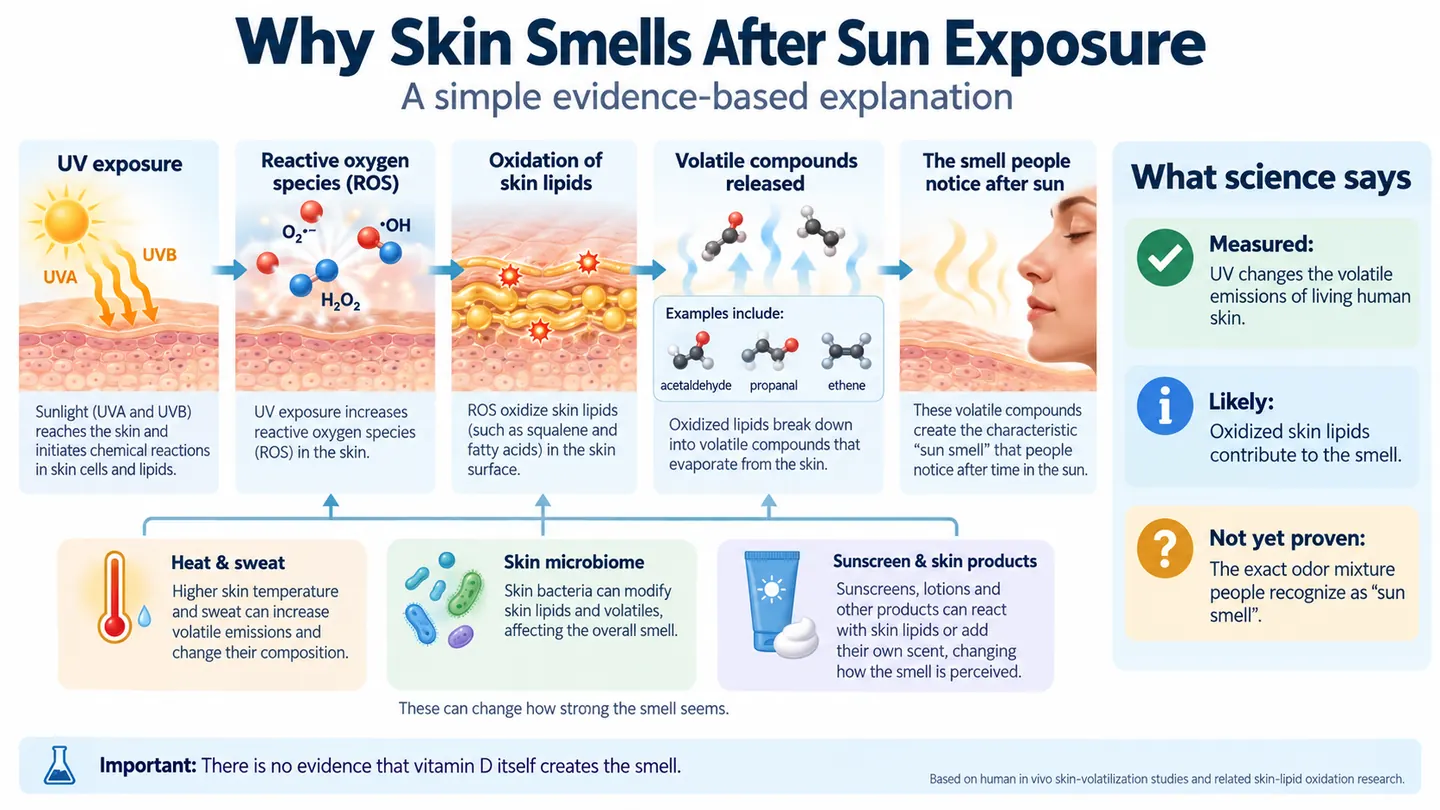
How could UV exposure turn into a smell?
Human skin is covered by a chemically active mixture of sebum, epidermal lipids, sweat, microorganisms and whatever products we apply to the surface. Many skin lipids contain unsaturated chemical bonds. UV radiation can generate reactive oxygen species (ROS), which can attack those lipids. The resulting oxidation reactions break larger molecules into smaller products, including volatile aldehydes that can evaporate from the skin.
This gives a simple working model:
UV radiation → reactive oxygen species → oxidation of skin lipids → volatile compounds → a changed skin odor.
The important distinction is that scientists have measured the UV-induced volatile emissions, but they have not yet shown which exact combination of molecules produces the familiar smell that people describe after being in the sun.
Measured, plausible, and still unknown
| Claim | Evidence | How strongly can we say it? |
|---|---|---|
| UV changes VOC emissions from living human skin | Direct in-vivo measurements | Measured |
| Acetaldehyde and propanal rise after UV exposure | Identified by analytical chemistry and related to UV intensity | Measured |
| Lipid oxidation contributes to the odor | UV experiment plus known oxidation chemistry | Likely |
| Sweat, microbiome and skin products change the final smell | Known determinants of the skin volatilome, but not isolated in a “sun smell” trial | Plausible modifiers |
| The exact molecules people recognize as “sun smell” | No direct sensory-to-chemical mapping found | Still unknown |
| Vitamin D production causes the smell | No supporting evidence found | Unsupported |
Why does the smell vary from person to person?
Because the skin surface is not a fixed chemical system. A 2026 review of the human skin volatilome identified several interacting sources of skin odor, including sebaceous lipids, sweat-gland secretions, microbial metabolism, lipid peroxidation and environmental exposures. The review included 55 studies and emphasized that skin VOC profiles vary with body site, age, sex, microbiome and environment. Mohammed et al., 2026 [3]
That helps explain why one person may notice a strong “warm”, “toasty” or slightly metallic odor while another notices almost nothing. The amount and composition of sebum differ. Skin temperature and sweating differ. Microbes transform compounds in sweat and sebum. Sunscreen, moisturizers and fragrances add another chemical layer.
Related experiments with ozone rather than UV are useful here, but they should not be confused with direct evidence about sunlight. Ozone reacts readily with skin-surface lipids such as squalene and produces many volatile carbonyl compounds. Studies also show that personal-care products can change the products released from this surface chemistry. This supports the broader idea that oxidizing skin lipids can change what evaporates from the skin, but it does not mean ozone is the cause of “sun smell”. Weschler & Nazaroff, 2023 [4]
Is “sun smell” just sweat or bacteria?
Probably not. Sweat and bacteria clearly affect body odor, especially in areas rich in apocrine glands, but the UV experiment measured a change in gases emitted directly from irradiated skin. That means there is a real photochemical component that does not require “sweat smells stronger in the heat” as the whole explanation.
The most realistic model is therefore additive: UV chemistry changes the skin’s volatile output, while sweat, microbiome, temperature and products modify what your nose finally detects.
Does vitamin D cause the smell?
I originally wondered about this because I noticed the odor seemed stronger during a period when I was taking vitamin D3. I still have not found evidence that vitamin D synthesis itself produces a volatile odor. UVB does drive vitamin D production in skin, but that is a separate biochemical pathway from the measured release of lipid-peroxidation products.
So the observation can be real while the first explanation is wrong. Season, UV intensity, exposed skin area, sweating, sebum composition, sunscreen and ordinary day-to-day variation are all alternative explanations. For the separate question of vitamin D production from sunlight, see Sunlight and Vitamin D: What Controls How Much You Make?
Why does skin smell after a tanning bed?
Tanning beds expose skin to ultraviolet radiation, so the same basic oxidation pathway is a reasonable explanation for the familiar “after-tan” odor. Heat, sweat and tanning products can add to it. Different tanning devices use different UV spectra, so the chemistry will not be identical in every case.
The odor is not a UV dosimeter. A stronger smell does not tell you how much vitamin D you made, and the absence of a smell does not show that a UV dose was harmless.
The evidence is direct, but still limited
The central human experiment is scientifically useful because it measured chemistry directly in living skin and followed the response in real time. But it was also small, with 16 volunteers, and it was not designed as a sensory study. Participants were not asked to rate “sun smell” while researchers simultaneously identified every odor-active molecule reaching the nose.
So we can say with reasonable confidence that UV changes the volatile chemistry of human skin and produces lipid-peroxidation markers. We cannot yet say that acetaldehyde plus propanal equals the smell people recognize after sun exposure. That last step remains an experimentally testable hypothesis.
Frequently asked questions
Why does my skin smell after being in the sun?
The best-supported explanation is that UV radiation changes the volatile chemicals released from skin, probably in part through oxidation of skin lipids. Sweat, bacteria and skin products can change the final odor.
Why does my skin smell after a tanning bed?
Tanning beds use ultraviolet radiation, so UV-driven lipid oxidation is a plausible contributor to the “after-tan” smell. Heat, sweat and tanning lotions can add their own effects.
Is the smell caused by bacteria?
Bacteria can modify skin odor, but they are unlikely to be the whole explanation. Human experiments show that UV itself changes volatile emissions from irradiated skin.
Does the smell mean my skin was damaged?
The measured VOCs are associated with UV-induced lipid peroxidation, but a person’s perception of odor has not been validated as a measure of UV damage. Your nose cannot reliably estimate UV dose.
Does vitamin D production create “sun smell”?
No evidence currently shows that vitamin D synthesis itself creates the odor. UV exposure can trigger vitamin D production and skin oxidation at the same time, which can make the two processes easy to confuse.
References
- Steeghs MML, et al. On-line monitoring of UV-induced lipid peroxidation products from human skin in vivo using proton-transfer reaction mass spectrometry. International Journal of Mass Spectrometry. 2006;253:58-64.
- Moeskops BWM, et al. Real-time trace gas sensing of ethylene, propanal and acetaldehyde from human skin in vivo. Physiological Measurement. 2006;27(11):1187-1196.
- Mohammed GF, et al. Human Skin Odor Throughout Life: A Literature Review. Journal of Cosmetic Dermatology. 2026;25(9):e71194.
- Weschler CJ, Nazaroff WW. Human skin oil: a major ozone reactant indoors. Environmental Science: Atmospheres. 2023;3:640-661.
So, y’know that stink after tanning? It’s just skin bacteria having a UV party. Tanners call it ATO. It gets worse if ya move around ‘n sweat before. You can wash it off, use lotions, or special products. No bacteria, no stink, ya get it? And funny thing, fake tan stuff puts the smell in on purpose. Makes it feel more real, I guess.