
Inspired by my earlier exploratory facial-age experiment, I analyzed images of David Sinclair from different years. The software estimates apparent facial age, not biological age. Lighting, camera quality, expression, image compression, selection of screenshots and algorithmic bias can all change the output, so the numbers below should be treated as a noisy image-analysis experiment rather than a measure of health, lifespan or biological rejuvenation.
2015

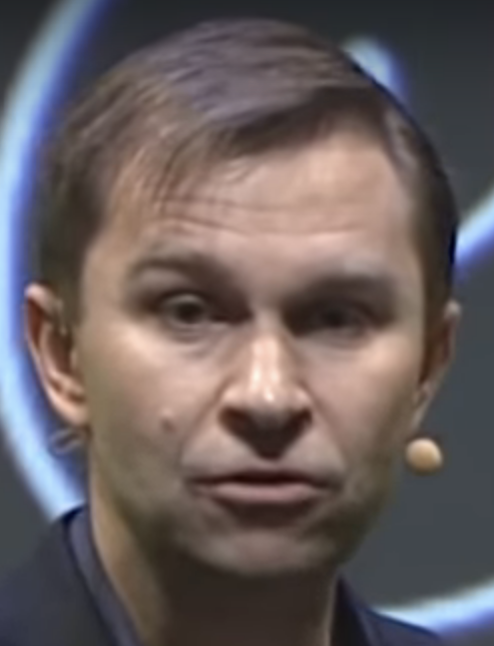

Source videos:
https://www.youtube.com/watch?v=2Yug9LzGkxs
https://www.youtube.com/watch?v=AiCvqnUIe04
https://www.youtube.com/watch?v=lA4DbN01q70
I only found two videos from 2015, so I included one from 2016.
Detected ages: (43 + 39 + 42)/3 = 41.3 years.
Actual age: 45.5 years.
Difference: 41.3 – 45.5 = -4.2 years.
2017


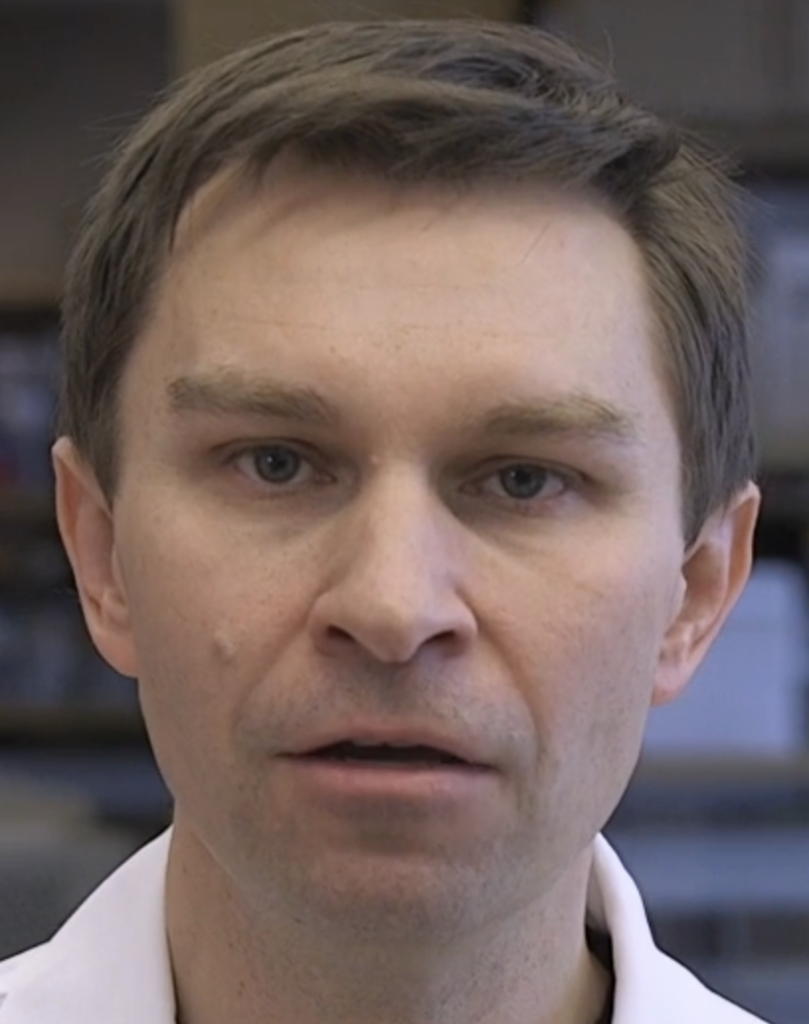
Source videos:
https://vimeo.com/208689854
https://www.youtube.com/watch?v=7DD31aBTE44
https://vimeo.com/261202564
Again, I had to include one video from 2018 as I couldn’t find three from 2017.
Detected ages: (45 + 42 + 42)/3 = 43.0 years.
Actual age: 47.5 years.
Difference: 43.0 – 47.5 = -4.5 years.
2019



Source videos:
https://www.youtube.com/watch?v=9nXop2lLDa4
https://www.youtube.com/watch?v=Eu0GksWf5pI
https://www.youtube.com/watch?v=IEz1P4i1P7s
Detected ages: (36 + 36 + 39)/3 = 37.0 years.
Actual age: 49.5 years.
Difference: 37.0 – 49.5 = -12.5 years.
2021



Source videos:
https://www.youtube.com/watch?v=GSkkBkMcwdY
https://www.youtube.com/watch?v=EKa9eEotA54
https://www.youtube.com/watch?v=BRFqPSy48b4
Detected ages: (32 + 32 + 39)/3 = 34.3 years.
Actual age: 51.5 years.
Difference: 34.3 – 51.5 = -17.2 years.
The unusually low 2021 estimates may partly reflect image quality. Several screenshots were blurred or lower resolution, which can smooth facial detail and alter age-estimation output. That is a methodological limitation, not evidence of unusually rapid rejuvenation.
2023



Source videos:
https://www.youtube.com/watch?v=_yCGV-Z3vhg
https://www.youtube.com/watch?v=fsUUgTPtwnc
https://www.youtube.com/watch?v=y6xk_qDwZ4A
Detected ages: (35 + 39 + 40)/3 = 38.0 years.
Actual age: 53.5 years.
Difference: 38.0 – 53.5 = -15.5 years.
If the 2021 values are partly an image-quality artifact, the remaining series still suggests that this particular algorithm has often estimated Sinclair as younger than his chronological age. What it cannot show is whether any anti-aging intervention caused that pattern or whether his biological aging slowed.
For more accurate averaging, I’ll also incorporate previous data I’ve collected on David. This leads to the following table (I’ve omitted the calculations for brevity):
| Year | 2015 | 2017 | 2019 | 2021 | 2022 | 2023 |
| Estimated-age gap | 4.2 | 4.5 | 11.8 | 17.2 | 14.0 | 15.2 |
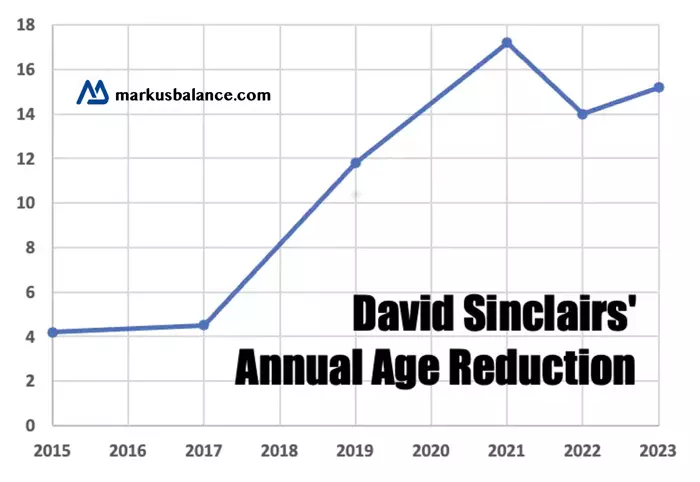
Sinclair has also discussed biological-age estimates from molecular tests, but those measurements are not directly comparable with facial-age software. Agreement between two different age-estimation methods would not by itself validate either one or establish a treatment effect.
A tempting next step would be to compare these image estimates with changes Sinclair reported making to his lifestyle. But this dataset cannot support that causal inference: the photos were not standardized, the algorithm is noisy, and many unmeasured factors changed across years.
2026 Update
In August 2026, I repeated the experiment using four screenshots from David Sinclair’s recent videos. The age-detection software produced an average estimated age of 41.0 years.
Sinclair was born on June 26, 1969, making his chronological age approximately 57.1 years at the time of this update.
Detected age: 41.0 years
Actual age: 57.1 years
Difference: 41.0 − 57.1 = −16.1 years
In other words, the software currently estimates Sinclair to look approximately 16 years younger than his chronological age.
Updated Dynamics
| Year | 2015 | 2017 | 2019 | 2021 | 2022 | 2023 | 2026 |
|---|---|---|---|---|---|---|---|
| Gain | 4.2 | 4.5 | 11.8 | 17.2 | 14.0 | 15.2 | 16.1 |
Compared with the direct calculation from 2023, his detected age increased from 38 to 41, while his chronological age increased from 53.5 to 57.1. Thus, the software aged his face by approximately three years while about 3.6 chronological years passed—an apparent aging rate of roughly 0.83 facial years per calendar year.
The difference between his detected and chronological ages increased slightly, from approximately 15.5 years in the original 2023 calculation to 16.1 years in 2026. The earlier summary table used 15.2 years for 2023 because it incorporated additional previous measurements; using that figure, the increase is 0.9 years. Either way, such a small difference is probably within the noise of this method.
The longer-term comparison is more striking: in 2015, Sinclair’s detected age was 41.3, and in 2026 it was 41.0. According to the software, his apparent facial age has therefore remained almost unchanged over approximately eleven calendar years. Meanwhile, his apparent age advantage increased from about four years to sixteen years. The new 2026 images show no clear acceleration in his apparent aging, but they also do not provide strong evidence that he has continued becoming younger.