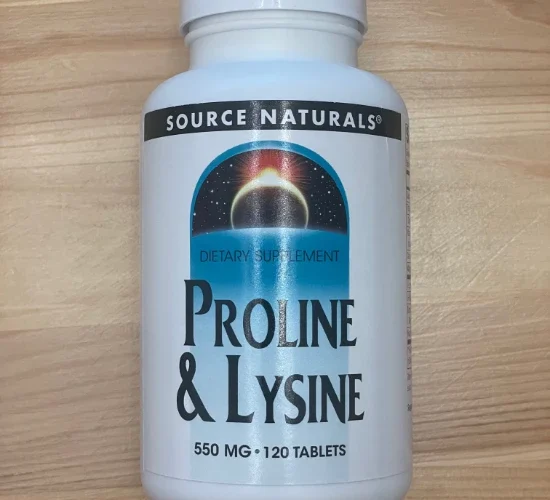
The original idea is worth preserving: proline and lysine are important amino acids in connective tissue biology, so it is reasonable to ask whether supplementing them can improve collagen-related outcomes. The mistake is assuming that because a molecule is required for a pathway, taking more of it necessarily accelerates that pathway.
What proline and lysine actually do
Lysine is an essential amino acid, meaning it must come from the diet. Proline can be synthesized by the body, although requirements may change in some physiological states. Both are present in collagen, and lysine/proline residues undergo hydroxylation during collagen maturation.
Vitamin C is also required for key hydroxylation reactions in collagen synthesis. In a person eating adequate protein and vitamin C, the rate-limiting factor is not necessarily a shortage of isolated proline or lysine.
The original hypothesis
The hypothesis I wanted to explore was: could providing extra collagen-building amino acids improve connective-tissue repair, skin, tendons or vascular integrity? Biochemically this is plausible. Clinically, evidence for isolated proline + lysine supplements is much thinner than the biochemical story suggests.
Skin and collagen
Proline and lysine are components of collagen, but I could not find strong clinical evidence that isolated proline or lysine supplementation by itself reliably reduces wrinkles, improves skin elasticity or accelerates normal wound healing in well-nourished adults.
There is a separate literature on collagen peptides, which contain mixtures of amino acids and peptides. Results from collagen-peptide studies cannot automatically be transferred to isolated proline or lysine.
Joints and tendons
The same distinction matters here. Collagen turnover is relevant to tendons and joints, but “proline participates in collagen” is not the same as “proline supplements treat tendon or joint disease.” Exercise loading, rehabilitation, total protein intake and diagnosis of the underlying problem remain more established.
Lysine and cold sores
This is one of the more interesting claims because there are actual human trials, but the results are mixed. Some older trials reported fewer recurrences or milder symptoms at higher lysine intakes, while other controlled studies found little or no benefit.
A Cochrane review of prevention strategies for herpes labialis reported that it did not find convincing evidence of efficacy for lysine. A later review concluded that doses below 1 g/day appeared ineffective and that larger, better controlled studies would be needed to clarify whether higher doses help selected patients.
So the hypothesis survives, but weakly: lysine may help some people with recurrent herpes labialis, but it is not established as a reliable substitute for antiviral therapy.
Arterial and cardiovascular health
The original article suggested that proline might help arterial walls and prevent atherosclerosis. I would no longer state that as an established benefit. Collagen is part of vascular structure, but I could not find good human evidence that proline or a proline-lysine combination prevents or reverses atherosclerotic cardiovascular disease.
For cardiovascular prevention, LDL reduction, blood-pressure control, smoking cessation, physical activity, diabetes management and evidence-based medications have much stronger outcome data.
Muscle growth
Lysine is required for protein synthesis because it is an essential amino acid, but taking lysine alone is not an anabolic shortcut. Muscle protein synthesis requires the full set of essential amino acids plus sufficient energy and a training stimulus.
Calcium and bone
There are mechanistic and small-study reasons to investigate lysine in calcium handling, but the evidence is not strong enough to recommend lysine as a stand-alone osteoporosis strategy. Adequate protein, calcium, vitamin D, resistance exercise and appropriate medical therapy remain the better-established framework.
Safety
A systematic review of human lysine supplementation found mainly gastrointestinal adverse effects and estimated a provisional no-observed-adverse-effect level around 6 g/day in healthy adults. That is a safety estimate, not a recommended dose. People with kidney disease, pregnancy, complex medication use or other medical conditions should not infer that high-dose supplementation is automatically appropriate.
What I would test
A useful trial would compare isolated proline + lysine with an isonitrogenous protein control, measure actual collagen-turnover markers and tissue outcomes, and distinguish people with adequate versus marginal baseline protein intake. Until then, the most defensible conclusion is that the biochemical rationale is stronger than the clinical evidence.
Sources
Cochrane review: prevention of herpes simplex labialis – did not find convincing evidence for lysine prophylaxis.
Lysine for herpes simplex prophylaxis: review of the evidence – mixed results and need for better controlled studies.
Safety assessment of oral L-lysine: systematic review, 2019 – human safety data and gastrointestinal adverse effects.