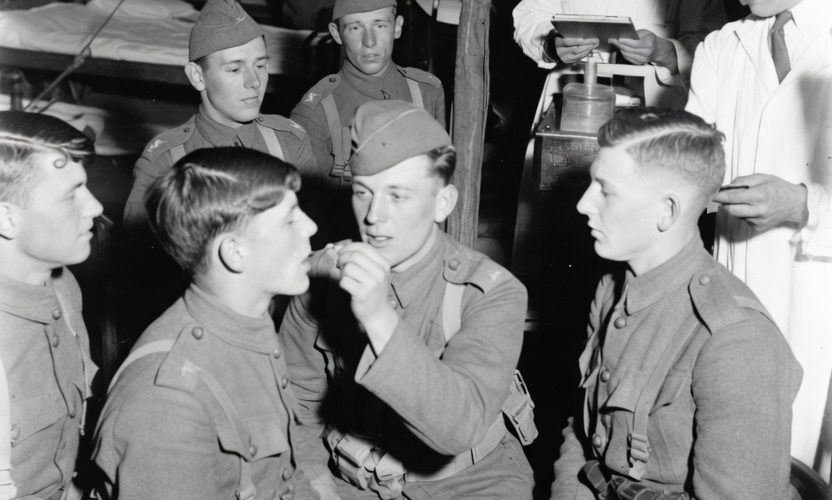
In the autumn of 1918, the American army ran into a very unpleasant problem. The “Spanish flu” was sweeping through the camps: soldiers were getting sick, people were dying, commanders were nervous, and doctors were trying to understand what was actually happening. And the question was not philosophical, not academic, not the kind of thing discussed at a conference with coffee breaks. The question was simple: how does this thing spread?
Today we are used to the idea that whenever flu appears somewhere, the answer is already known in advance. A sick person releases a virus, another person inhales it, the virus multiplies, and illness begins. Everything is neat, clear, almost like a school animation: tiny balls fly from one nose into another, then triumphantly take over the body. Science likes pictures like that. They look good on posters.
But in 1918, military doctors acted more simply. They had not yet developed the habit of burying a simple question under thirty layers of terminology. They reasoned almost crudely, like soldiers: if flu is contagious, then take material from a sick person and transfer it to a healthy one. If the healthy person gets sick, it spreads. If he does not get sick, then something in the model is wrong.
And a group of doctors connected with Milton Rosenau ran exactly that kind of experiment: they took secretions from the noses and throats of flu patients. Not old, dried-out, symbolic material, but fresh material. They put it into the noses, throats, and eyes of healthy volunteers. They took blood from sick patients. They used filtered and unfiltered material. Then they went even further, to the most direct version possible: sick patients were seated next to healthy volunteers, face to face, and told to cough directly into their faces.
Yes, exactly that. Not metaphorically. A sick person coughs into a healthy person’s face to test whether flu is transmitted.
Today, that description sounds almost obscene. An ethics committee would faint, get up, write eight protocols, faint again, and then apply for a grant to study its own trauma. But at the time there was war, soldiers, death, an epidemic, and people wanted to understand what was really going on.
The result was extremely inconvenient: the flu did not spread.
Not “it spread weakly”. Not “it spread, but not to everyone”. Not “mild symptoms appeared, requiring further analysis”. They simply failed to reproduce the disease. After all that direct, almost barbaric testing, the expected picture did not appear.
There is another point here that almost nobody discusses. People back then, especially soldiers, were psychologically very different test subjects. They did not live inside the modern medical culture, where a person already knows what he is supposed to fear, what symptoms should appear, what “infection” is supposed to look like, and on which day he should start paying attention to his throat. A soldier in 1918 was probably just told: here is the experiment, stand there, endure it. He did not sit afterward with a phone, googling “first signs of flu after contact with sick person”. He had no anxious patient forum, no smartwatch, no heart rate variability chart, and no inner screenwriter capable of producing half the symptoms overnight.
If such an experiment were carried out today, I am almost sure that some percentage of symptoms would appear simply from expectation. Twenty percent? Thirty? Maybe less, maybe more. But a modern person who is officially told, “now we are going to infect you with flu”, is no longer a clean biological object. He is a small theater of psychosomatics, anxiety, suggestion, and cultural expectations. He may start coughing not because he got infected, but because he was just told that he was supposed to get infected.
And against that background, the zero result of those old experiments looks even stranger. Because if flu were such a simple and easily transmitted thing, as we are usually told, then directly applying fresh material from sick patients, blood, mucus, coughing into faces – all of that should have produced at least some noticeable wave of clinical illness. Especially during a real epidemic. But it did not.
The most interesting part comes next: after such a result, science should seemingly have said, “wait, something does not add up here, let us repeat it, let us test it under different conditions, let us figure out why the direct experiment does not work.”
But history took a different path. First came laboratory strains. Then cultures. Then serology. Then tests, titers, antibodies, PCR, “laboratory-confirmed infection”, challenge studies, surrogate endpoints, and all the other civilized luxuries. The question gradually began to look much more intelligent. But at the same time, it became less direct.
Before, the question was: did the person get sick or not?
Now, more and more often, the question is: did we find a marker in the person which, within our model, is considered a sign of infection?
But these are not the same thing.
A person with no symptoms, in whom something was found in a test, is not a flu patient in the normal human sense. He is a person in whom a laboratory detected what it is able to detect. The “asymptomatic carrier” of the 2020 variety, yes, that one))
Maybe what they found is important. Maybe it means something. But it is not the same thing as clinical illness.
This is where the main strangeness appears. The most direct experiment was performed more than a hundred years ago. It gave a negative result. And then, instead of repeating the same simple, crude, but understandable experiment, science moved toward increasingly complex laboratory models.
One can, of course, say that this is exactly how science is supposed to develop. Methods become more precise, instruments become better, models become more complex. There is truth in that. But there is another possibility: sometimes complexity appears not because the question has become deeper, but because the simple question gave an inconvenient answer.
And that simple question is still hanging in the air: if flu is so contagious in the direct sense, why did the most famous series of clean human experiments using material from sick patients fail to cause flu in healthy people?
You can argue about the details. You can say that the volunteers already had immunity, that the timing of the illness was wrong, that the route of transmission was wrong, that the strain was wrong, that the humidity was wrong, that the coughing angle was wrong, and that the phase of the Moon was wrong. The human mind is magnificent at rescuing its favorite theories.
But a negative result remains a negative result.
And if we are being honest, the story does not look the way it is usually presented. It is not as if the simple contagiousness of flu was once directly proven, and modern virology was then built on that foundation. Rather the opposite: when simple contagiousness was tested in the most direct possible way, it was not confirmed. After that, the foundation was reinforced with other things – epidemiology, laboratory markers, animal models, and artificial infection using prepared strains.
All of that may be useful. All of that may show something. But it is no longer the same clean question: a sick person transfers fresh material to a healthy person – does the healthy person develop flu?
And history gave a surprisingly inconvenient answer to that question: no, he did not.
In more than a hundred years since Rosenau’s experiments, nobody has repeated the same clean human experiment in its original form. Not a challenge study with a laboratory-prepared strain. Not a PCR model. Not a “laboratory-confirmed infection”. Not artificially grown material with a preselected dose.
But the simple, almost crude question itself: fresh material from a sick person -> into a healthy person -> does clinical flu appear?
Science has learned, in the meantime, to edit genomes, transplant organs, grow embryos in vitro, create mRNA platforms, and photograph black holes. But somehow it never got around to repeating the most direct experiment on the infectiousness of flu.
And then a curious question arises: if something as basic as the direct infectiousness of flu has still not received clean modern human confirmation after more than a hundred years, then how reliable is our “common knowledge” foundation in general?
How many things that we supposedly “know from childhood” exist not because they are constantly rechecked through direct experiments, but because the system once arrived at a convenient consensus and then began building floors on top of it?
Disclaimer
The information provided in this article is for general informational purposes only. The content presented on this website should be considered solely as opinions and personal experiences. Read more
And this is where another strange thread appears, one that people usually avoid discussing too openly unless they want to be treated like someone who asks the wrong kind of questions at dinner parties. If the direct experiments attempting to transmit influenza from sick people to healthy volunteers failed, then an honest investigator should at least pause for a moment and ask: what other major environmental changes were happening at the same time?
Because the 1910s were not only about war and overcrowded military camps. They were also the years when humanity began flooding the planet with radio waves for the first time. Giant spark transmitters, antennas the size of small mountains, naval radio stations, military wireless communication networks, massive long-range transmitters operating at unprecedented power levels. All of this was expanding rapidly during the exact years when the Spanish flu appeared. Some later researchers noticed an uncomfortable pattern: many of the earliest outbreaks clustered around military communication centers, naval facilities and powerful radio installations.
Of course, correlation is not proof of causation. Otherwise humanity would have scientifically confirmed long ago that storks deliver babies and ice cream causes drowning. But the problem is that after the Rosenau experiments failed, the question can no longer be dismissed quite so casually. If the disease could not be reliably reproduced through direct contact and fresh material from sick patients, then environmental factors stop looking completely absurd and start becoming at least legitimate subjects for investigation.
Especially because the Spanish flu itself behaved in unusually strange ways. Severe bleeding, impaired blood clotting, neurological symptoms, hair loss months later, cardiac conduction abnormalities, and extremely high mortality among strong young adults. None of this neatly resembles the simplified textbook picture of a straightforward respiratory virus. That does not prove an electrical cause. But it does raise uncomfortable questions about how honestly the history of the pandemic is usually presented.
And perhaps the most unsettling thought here is not even about radio waves. It is something broader. If such a basic question – whether influenza directly passes from a sick person to a healthy person – was never seriously re-tested with a modern clean human experiment after those early failures more than a century ago, then how much of what we casually call “settled science” actually rests on direct reproducible evidence, and how much simply rests on an old consensus that later generations kept building on top of?
The timing with 5G is interesting: China launched commercial 5G in autumn 2019, and the Wuhan cluster appeared at the end of 2019. But the simple idea “5G was turned on, so covid started” does not really hold up. South Korea launched mass 5G earlier, and covid also spread to places where there was almost no 5G at the time.
Starlink is also not a simple fit. The first test satellites were launched in 2018, the first major launches happened in 2019, but the real growth of the satellite network came after covid had already appeared. Still, if the body reacts not only to the strength of a signal, but also to a new type of signal, rhythm, or electromagnetic environment, then an early adaptation reaction could theoretically have started quickly.
In that case, this is not about one button being switched on and people suddenly getting sick. It is more like a change in the whole “electric weather”: 5G, satellite networks, higher wireless density, military and civilian communication systems. Maybe the environment triggers maladaptation in some people, and then what spreads between people is not a “virus” in the usual sense, but some kind of physiological adaptation pattern – through stress, breathing, the microbiome, behavior, the nervous system, or some mechanism we do not yet understand.
This does not prove that 5G or Starlink caused covid. But it is also strange to remove the electromagnetic environment from the analysis just because the question is uncomfortable. Especially when the simple model “one virus – one disease – one cause” is not as solid as we are usually told.