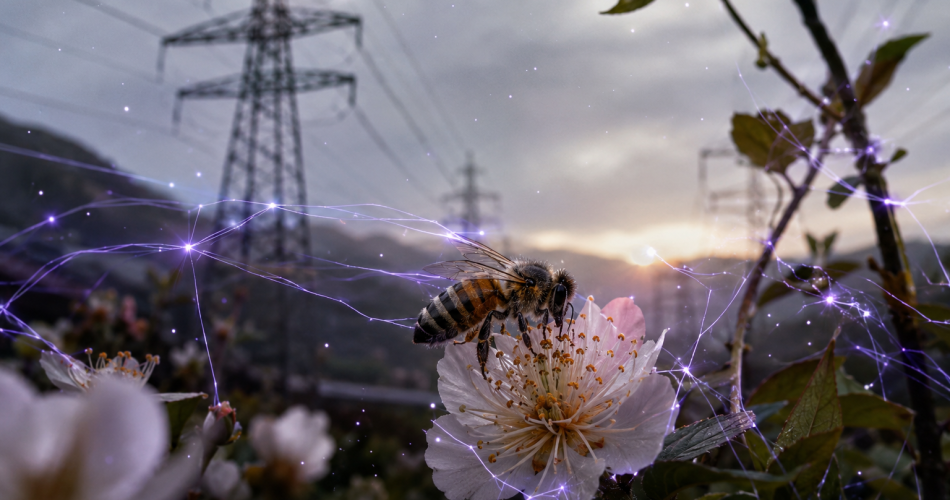
We live inside electric fields so quietly that it is easy to forget they are there.
Between the ground and the atmosphere exists a natural electrical potential gradient. Thunderstorms help maintain the global atmospheric electric circuit. Cells maintain voltage differences across membranes. Nerves signal electrically. Plants move ions and generate electrical potentials.
Once you notice this layer, biology begins to look less like chemistry floating in water and more like chemistry wired into an electrical world.
That observation is real. The temptation is to sprint from it into a much larger claim: perhaps modern electromagnetic noise is disrupting the biosphere. That question is worth asking, but the bridge between the two ideas is where evidence matters most.
The planet really does have an electrical environment
The atmosphere is not electrically neutral in a simple everyday sense. Electric fields vary with weather, altitude and local conditions. Living organisms evolved inside this environment.
At the cellular level, electrical gradients are fundamental. Ion channels, membrane potentials, calcium signaling and electrical impulses are ordinary biology, not fringe physics.
Plants are electrical organisms, but not antennas in the simplistic sense
Plants transport ions through tissues, generate membrane potentials and use electrical and calcium signals in responses to damage and environmental change.
The geometry of roots, leaves, hairs and branches can also influence charge distribution and interaction with the surrounding air. But saying that a tree is literally an atmospheric antenna designed to harvest electricity goes beyond what the evidence supports.
Interesting electrobiology does not require teleology.
The bee-flower story is where things become genuinely strange
Here the evidence is unusually elegant.
Flying bees can carry positive electric charge, while flowers are typically at a different electrical potential relative to the atmosphere and ground. Experiments have shown that bumblebees can detect floral electric fields and use them as one of several cues during foraging.
Researchers also found a plausible sensory mechanism: tiny mechanosensory hairs on bumblebees bend in weak electric fields and generate neural responses.
Even pollen transfer is influenced by electrostatic forces. This is not metaphor. It is part of the sensory ecology of pollination.
So does artificial electromagnetic noise confuse bees?
This is the obvious next question, and it is much harder.
Natural electrostatic floral fields and anthropogenic radiofrequency electromagnetic fields are not the same phenomenon. Different frequencies, field strengths and coupling mechanisms matter. The fact that bees can sense one kind of electric cue does not automatically prove that Wi-Fi or 5G disrupts that sensory channel.
There are laboratory and field studies reporting biological effects of radiofrequency exposure in insects. A 2023 controlled honey-bee study found impaired homing under one simulated RF-EMF exposure while finding no effect on brood development or longevity.
But a large systematic evidence map published in 2024 found that most environmental RF-EMF studies were laboratory experiments and that the majority had poor methodological quality. Ecological consequences in real environments therefore remain uncertain.
What about the studies claiming clear insect harm?
Some reviews conclude that laboratory effects are common enough to deserve serious attention. Others emphasize weak methods, heterogeneous exposure systems and the difficulty of extrapolating from laboratory organisms to ecosystems.
Those positions are not mutually exclusive. There can be a real biological interaction and still be major uncertainty about its ecological size in the real world.
The intellectually useful answer is therefore neither “electromagnetic fields are harmless background” nor “radio waves are killing the bees.” It is: there is a signal worth studying, and the field evidence is not yet strong enough for a simple causal story.
Electroculture: the beautiful historical detour
In the nineteenth and early twentieth centuries, experimenters placed wires, electrodes and metallic structures around crops and reported changes in growth and yield. The subject later accumulated a mixture of serious experiments, inconsistent protocols and extravagant claims.
Modern research continues to examine plant responses to electric, magnetic and electromagnetic fields. Reviews report physiological and molecular responses, but results vary greatly with species, frequency, intensity and exposure conditions.
So the old “electric garden” idea is not simply nonsense. It is also nowhere near a mature agricultural technology with one reliable recipe.
And what about Varroa mites?
The previous version of this article suggested that parasites such as Varroa destructor might be more a symptom of a destabilized bee system than a primary cause of collapse.
That framing was too philosophical.
Varroa is a major biological stressor in honey bees and a vector for important viruses. Nutrition, pesticides, pathogens, genetics, management and habitat can interact with parasite pressure, but there is no need to demote a well-established cause into a mere “indicator of lost resilience.”
The deeper idea that survives
Modern biology often separates topics for convenience: electrophysiology over here, ecology over there, atmospheric physics somewhere else.
Nature does not respect department boundaries.
A flower can be simultaneously a biochemical factory, a mechanical structure, an optical signal, a humidity source and an electrical object. A bee can detect several of those channels at once.
The discovery of floral electroreception is a reminder that organisms may use environmental information we once ignored.
The question worth keeping
Has modern technology altered some of those weak environmental channels enough to matter ecologically?
Possibly. That is a legitimate research question. But the answer must come from well-controlled exposure studies and field ecology, not from the fact that life itself is electrical.
The electrical layer of the biosphere is real. Its vulnerability to our electromagnetic infrastructure remains an open quantitative problem.
Bottom line
Plants and animals use electrical phenomena in real, measurable ways. Bumblebees can detect floral electric fields through mechanosensory hairs, and electrostatic forces participate in pollination. Artificial RF-EMF can produce biological effects under some experimental conditions, but current environmental evidence is heterogeneous and often methodologically weak. The fascinating part is not that we have discovered a hidden universal explanation. It is that biology has one more sensory and physical layer than most of us were taught to notice.
References
- Detection and learning of floral electric fields by bumblebees. Science, 2013.
- Mechanosensory hairs in bumblebees detect weak electric fields.
- Defined RF-EMF exposure in honey-bee colonies: homing, brood development and longevity.
- Systematic map of anthropogenic radiofrequency electromagnetic fields in animals and plants.