Research note: This article reports an exploratory, AI-assisted re-analysis of a public dataset based on a question I had previously raised. It has not been peer-reviewed and should not be read as a diagnostic study.
In January 2024, I published an article called “Clockwise or Counterclockwise? The Health Implications of Rotational Directions.” At the end, I wrote that the subject still fascinated me and that I wanted to investigate whether the direction in which the body rotates could somehow relate to health.
That earlier article was intentionally speculative. It mixed several very different kinds of “rotation,” including shift-work schedules and physical spinning, and I did not have a dataset that could answer the body-movement question directly.
Now I do.
For this follow-up, I used an AI-assisted re-analysis of three days of continuous movement recordings from 71 community-dwelling older adults in the open Long Term Movement Monitoring Database (LTMM). My original hypothesis was simple: if a person accumulates more clockwise than counterclockwise turning, or vice versa, does that directional preference correlate with balance, mobility, cognition, or a history of falls?
The answer was not the one I expected.
What I wanted to test
There were really two separate questions.
- Do people have a repeatable preferred turning direction in ordinary daily life?
- If they do, is the direction or strength of that bias related to health?
The second question was the original motivation. But the first turned out to be interesting in its own right.
The dataset: 71 people, three days of real life
The LTMM dataset was created to study gait, stability and fall risk. It contains roughly three days of lower-back movement recordings from 71 older adults living independently in the community. The cohort had a mean age of about 78 years, with an age range of 65–87 years. The public files also contain clinical and demographic information, including fall history and standard mobility and balance tests. The dataset is described by PhysioNet and in the original study by Weiss and colleagues, published in Neurorehabilitation and Neural Repair.
The raw recordings include a yaw-velocity signal, meaning rotation of the trunk around the vertical axis. The analysis used that signal to identify natural turning events and calculate how much angular movement accumulated in one direction versus the other.
Because gyroscopes can drift, the analysis did not use the raw three-day average. It applied local bias correction and detected turning episodes using angular-velocity and minimum-angle criteria. The analysis was repeated with different turn-size thresholds, especially ≥45° and ≥90°, so that the conclusion would not depend on one arbitrary definition.
For each participant, the analysis calculated a normalized directional bias:
(rotation in direction A − rotation in direction B) / total rotation
A value near zero means almost balanced turning. Positive and negative values mean that one direction accumulated more rotation than the other. For the health analysis, the absolute physical label CW versus CCW is not critical: reversing the sensor sign would flip every participant’s sign but would not change the strength or statistical significance of any association with health.
Result 1: many people really do show a repeatable directional bias
This was the most surprising part.
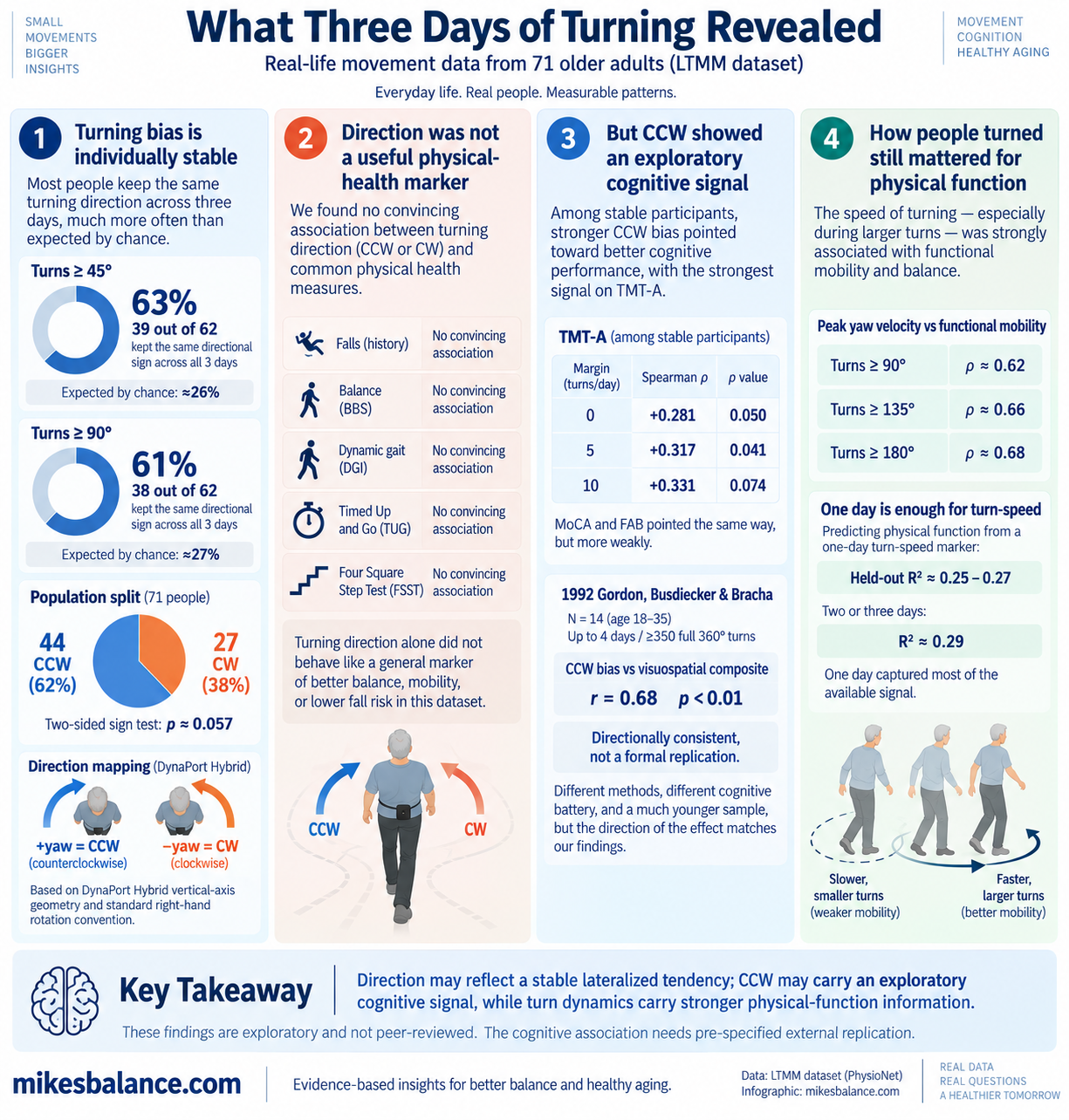
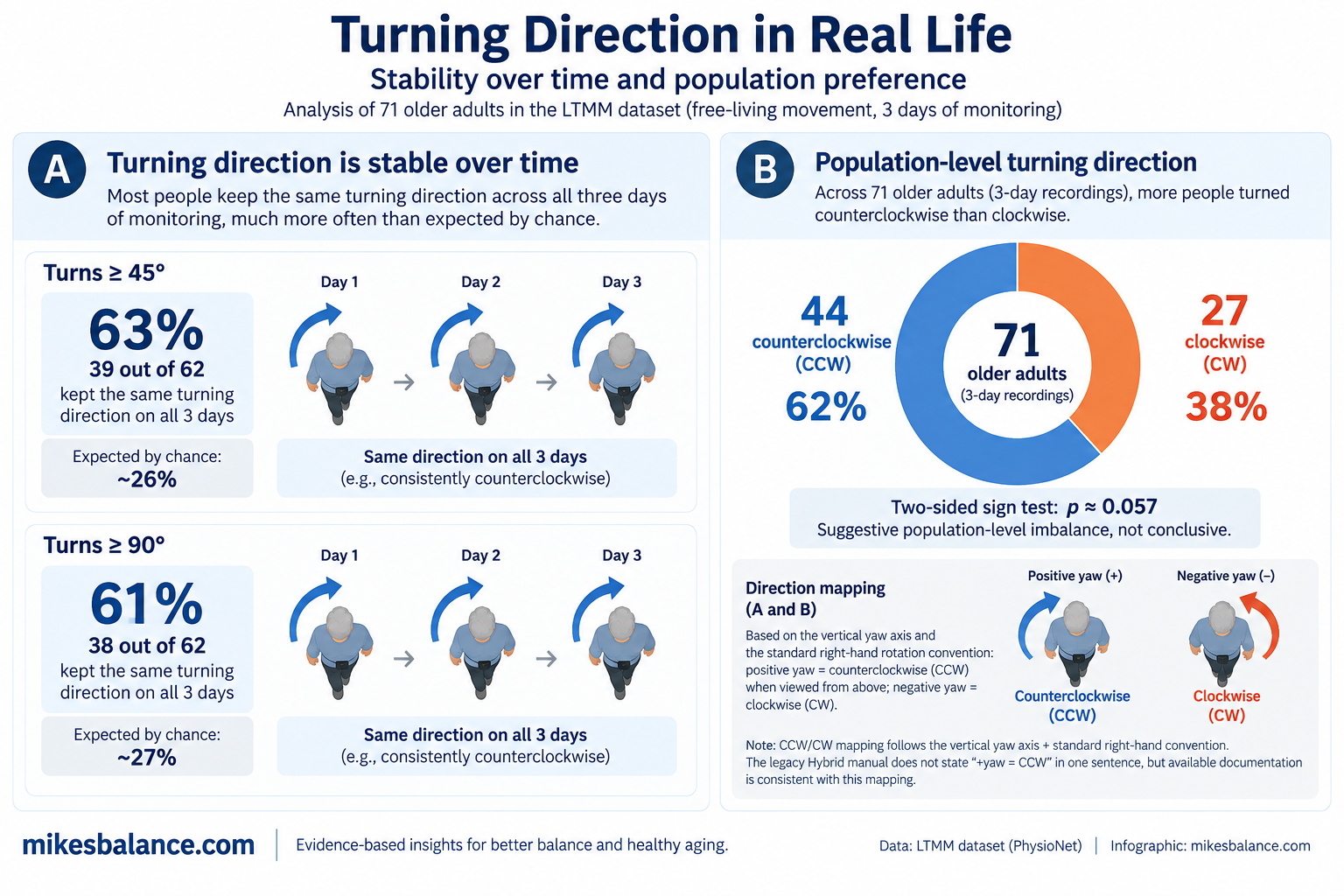
For turns of at least 45°, 39 of 62 participants with three fully usable days, or 63%, kept the same directional sign on all three days. Under an independence model using the observed daily proportions, only about 26% would be expected to keep the same sign all three days by chance. The probability of seeing this much agreement under that model was about 1.5 × 10⁻⁹.
Using only larger turns of at least 90° produced almost the same result: 38 of 62 people, or 61%, kept the same sign across all three days, versus an expectation of about 27% under day-to-day independence (p ≈ 2.1 × 10⁻⁸).
| Analysis | Observed stable sign | Expected if days were independent |
|---|---|---|
| Turns ≥45° | 39/62 (63%) | ≈26% |
| Turns ≥90° | 38/62 (61%) | ≈27% |
So the daily imbalance is not behaving like pure random noise. Many individuals appear to have a repeatable free-living turning tendency.
The result should not yet be called a permanent biological “phenotype.” Three days in the same home and habitual environment cannot separate a person’s intrinsic motor preference from the geometry of that environment. A kitchen layout, a favorite chair, a staircase or a repeated daily route can also create directional repetition.
“Repeatable person-specific free-living directional bias” is a more defensible description of what the data show.
Is there a population-wide preferred direction?
Across the full three-day recordings, 44 participants showed a positive yaw bias and 27 a negative yaw bias, both for the ≥45° and ≥90° definitions. With the DynaPort yaw axis interpreted using the documented vertical-axis geometry and the standard right-hand convention, positive yaw corresponds to counterclockwise (CCW) rotation when viewed from above, and negative yaw to clockwise (CW) rotation. In other words, the population split was 44 CCW versus 27 CW. A two-sided sign test gives p ≈ 0.057.
That is intriguing, but it is not enough to establish a universal preferred direction in this older population. It is a borderline signal in a relatively small sample. One instrumentation caveat remains: no legacy DynaPort Hybrid manual was located containing the literal sentence “positive yaw = CCW.” The mapping used here follows from the documented fact that DynaPort Hybrid yaw is rotation around the vertical axis together with the standard right-hand positive-rotation convention, under which positive rotation about an upward vertical axis is counterclockwise when viewed from above.
Interestingly, a completely separate 2026 paper in Nature Communications reported a robust population-level counterclockwise locomotor bias across several controlled pedestrian experiments in Spain and Japan. The authors concluded that the collective pattern arises from individual locomotor tendencies rather than only from crowd interactions. That study is worth reading because it suggests that directional locomotor asymmetry is a real human phenomenon, even though the exact mechanisms remain unclear.
Result 2: turning direction was not a useful physical-health marker
This was the original physical-health hypothesis, and the result was essentially negative.
The directional-bias measure was tested against fall history and standard measures of physical balance and mobility. Those correlations were small and statistically unconvincing.
| Outcome | Spearman ρ with ≥90° directional bias | p-value |
|---|---|---|
| Falls in previous year | −0.058 | 0.63 |
| Berg Balance Scale (BBS) | +0.108 | 0.37 |
| Timed Up and Go (TUG) | −0.092 | 0.45 |
| Dynamic Gait Index (DGI) | +0.042 | 0.73 |
| Four Square Step Test (FSST) | +0.003 | 0.98 |
The same basic null result appeared for the physical outcomes with the ≥45° definition and when the bias was converted into a simple positive-versus-negative direction.
So, within this dataset, the analysis found no evidence that accumulating more rotation in one direction is healthier than accumulating it in the other.
That matters because it is easy to build stories around clockwise and counterclockwise motion. Cultural practices, sports, ritual movement, running tracks, dance and vestibular sensations all make direction feel meaningful. In these data, directional preference does not behave like a useful general marker of better physical balance, better mobility or fewer previous falls.
But cognition told a different story
Once the sensor sign was resolved, the cognitive results became more interesting. Positive DynaPort yaw corresponds to counterclockwise (CCW) turning and negative yaw to clockwise (CW) turning. Among participants whose directional bias was stable enough to classify, a stronger CCW bias consistently pointed toward better cognitive performance.
The strongest individual signal was in TMT-A. Across increasingly strict stability/magnitude thresholds, the reported association remained in the same direction: at a 0-turn/day margin, ρ = +0.281, p = 0.050; at 5 turns/day, ρ = +0.317, p = 0.041; and at 10 turns/day, ρ = +0.331, p = 0.074, although the sample became smaller at the strictest threshold. MoCA and FAB also repeatedly pointed in the direction more CCW bias = better cognition, but their individual associations were weaker.
A composite cognitive measure remained positively associated with CCW bias after adjustment for age, sex and total turning volume. Adding PASE physical-activity level weakened the association substantially. That attenuation is important: activity may be a confounder, mediator, or simply a source of shared variance, so this should be treated as an exploratory cognitive signal rather than a settled biomarker.
A striking echo of a 1992 study
This pattern has an unexpected precedent. In 1992, Gordon, Busdiecker and Bracha studied just 14 young adults aged 18–35. Participants wore a belt-mounted rotation counter for up to four consecutive days or until at least 350 complete 360° turns had been recorded. Greater counterclockwise turning bias was strongly associated with better visuospatial performance (r = 0.68, p < 0.01), while clockwise-biased participants tended to perform worse. The association was specific to visuospatial rather than verbosequential performance. The paper is available through PubMed.
Our analysis is not a formal replication. The 1992 study counted complete 360° rotations; LTMM captures continuous natural yaw asymmetry. Their cognitive battery targeted visuospatial ability directly, whereas LTMM contains TMT-A/TMT-B, MoCA and FAB. The age groups are also almost opposites: their sample was young, while LTMM contains 71 older adults with a mean age around 78.
What is noteworthy is the direction of the effect: in two very different datasets, separated by more than three decades, greater CCW relative to CW turning points toward better visually mediated or executive-spatial cognitive performance. That convergence is more interesting than any single borderline p-value and deserves a direct, pre-specified replication.
The unexpected result: how you turn mattered much more than which way
After the original physical-health hypothesis was not supported, the analysis explored other properties of the same natural turns. Here the picture changed dramatically.
The strongest signal was peak yaw velocity during large turns. People with better concurrent functional mobility tended to generate higher peak trunk-rotation speeds during larger everyday turns.
A combined functional-mobility factor was created from four standard tests: BBS and DGI, where higher scores are better, and TUG and FSST, where faster times are better. Mean peak yaw velocity showed the following correlations with that factor:
| Natural turn size | Correlation with functional mobility |
|---|---|
| ≥90° turns | ρ ≈ 0.62 |
| ≥135° turns | ρ ≈ 0.66 |
| ≥180° turns | ρ ≈ 0.68 |
For ≥180° turns, peak velocity correlated individually with BBS at about ρ = +0.55, DGI at +0.52, TUG at −0.57 and FSST at −0.61. In other words, the same turning characteristic pointed in the expected direction across four different mobility tests.
This part of the analysis is exploratory and should not be mistaken for an externally validated biomarker. But it is consistent with previous research showing that the quality of natural turns can carry information about mobility and fall risk. For example, a longitudinal study of community-dwelling older adults found that natural turn quantity, duration, angular variability and turn quality were associated with future recurrent falls. That study monitored more than 700,000 turns and emphasized that turning in daily life contains information that straight-line gait testing can miss.
One day may already contain most of the signal
A second exploratory finding was that turn speed was surprisingly stable from day to day. Using mean peak yaw velocity during turns of at least 135°, the association with functional mobility remained similar on each individual day.
In participant-level held-out validation, a simple one-feature model using one day of yaw data achieved roughly R² ≈ 0.25–0.27 and Spearman ρ ≈ 0.60 for the functional-mobility factor. Averaging the first two days raised R² only to about 0.29, and using up to three days remained around 0.29. In this dataset, one day therefore captured most of the available signal. For research protocols focused on this specific turn-speed marker, a one-day recording may be the more efficient default when participant burden, battery life, time, or cost matters; additional days can be reserved for cases where a small gain in precision is worth the extra effort. This should not be generalized to every gait or fall-risk metric.
Again, this is internal validation in the same cohort, not proof that a phone or wearable can diagnose mobility problems. But it suggests an interesting direction: a passive sensor may learn more from how confidently a person turns than from whether that person tends to turn left or right.
What I think the result means
My current interpretation is that two different properties of movement are being mixed when we casually talk about “turning.”
Directional preference may reflect individual lateralization, habit and environment. It seems surprisingly repeatable over several days, but in this cohort it was almost orthogonal to functional health.
Turn dynamics, especially the ability to generate faster large turns, look much more like functional capacity. They depend on balance, coordination, motor planning and the willingness or ability to move decisively.
That distinction is useful. A behavioral trait can be real without being a health marker.
What this study does not prove
- The participants were 71 community-dwelling older adults, not a representative sample of all ages.
- Three days are enough to show short-term repeatability, but not lifelong stability.
- People spent those days largely in their normal environment, so home layout and habitual routes may contribute to directional bias.
- This is a secondary exploratory analysis of a public dataset, not a preregistered trial.
- The turn-dynamics findings were discovered after the original directional hypothesis was tested, so they need external replication.
- The dataset contains retrospective fall history; this is not the same as prospectively predicting future falls.
The honest conclusion
When I wrote about clockwise and counterclockwise movement in 2024, I suspected that rotation direction itself might carry some information about health.
After revisiting that idea through an AI-assisted analysis of three days of real-world sensor data from 71 older adults, I do not see evidence supporting it.
Clockwise versus counterclockwise accumulation does not appear to be a useful marker of physical mobility or fall history in this dataset. However, the exploratory cognitive analysis points in a different direction: greater CCW bias was associated with better cognitive performance, especially on TMT-A, and the direction of that effect echoes a small 1992 visuospatial study.
But the experiment did uncover something I did not initially expect: many people show a remarkably repeatable personal turning-direction bias from day to day. That makes directional locomotor bias an interesting behavioral phenomenon in its own right, while the new cognitive analysis raises the possibility that one aspect of that bias may also carry information about visuospatial or executive function.
For physical function, the clearest information was still in how people turned: faster large turns tracked better mobility. For cognition, however, which way may matter too: the exploratory signal consistently favored counterclockwise turning.
That is a result I am happier to publish than a convenient confirmation of my original idea.
Sources and further reading
- Faranov M. Clockwise or Counterclockwise? The Health Implications of Rotational Directions. Mike’s Balance, 2024.
- PhysioNet: Long Term Movement Monitoring Database (LTMM).
- Weiss A, Brozgol M, Dorfman M, et al. Does the Evaluation of Gait Quality During Daily Life Provide Insight Into Fall Risk? Neurorehabil Neural Repair. 2013.
- Echeverría-Huarte I, Feliciani C, Shi Z, et al. Individual locomotor bias drives counterclockwise motion in pedestrian crowds. Nature Communications. 2026.
- Natural turn measures predict recurrent falls in community-dwelling older adults: a longitudinal cohort study.
- Gordon HW, Busdiecker EC, Bracha HS. The relationship between leftward turning bias and visuospatial ability in humans. International Journal of Neuroscience. 1992.
- Bagalà F. From fall-risk assessment to fall detection: inertial sensors in the clinical routine and daily life. University of Bologna PhD thesis, 2012. Technical description of DynaPort Hybrid axes and gyroscope outputs.
- Example LTMM WFDB header (CO001), showing the yaw-velocity channel in degrees/s with positive gain.
Featured image and infographics are AI-generated visualizations based on the analysis described above. This article reports an exploratory analysis and is intended for research and educational discussion, not medical diagnosis or treatment.