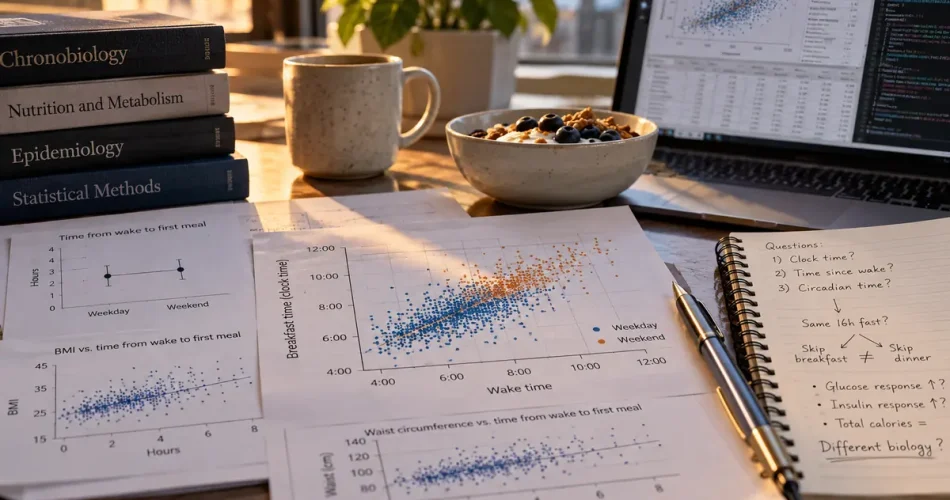
At 8:30 a.m., Anna sits down to breakfast. She has been awake for three hours. Half an hour later, Ben eats his first meal, just thirty minutes after getting out of bed. Who had the late breakfast? The kitchen clock says Ben. Time since waking says Anna. Neither measure, on its own, tells us what time it is inside their bodies.
This is the quiet problem behind some very loud arguments about breakfast. Researchers can disagree about whether eating early matters before they have agreed on what early means. One study measures hours after midnight; another measures hours after sleep; a laboratory can sometimes measure biological night itself. Before asking whether breakfast is too late, we need to know which clock is doing the judging.
Even researchers do not fully agree on what breakfast is
There is no single operational definition of breakfast. In one study, breakfast is the first meal after the longest period of sleep. In another, it must be eaten within two or three hours of waking. In a third, researchers simply draw a line on the clock. This difference matters: in the International Breakfast Research Initiative, national dietary datasets had to be handled differently because the available definitions were not compatible. In the UK dataset, for example, breakfast was defined by a morning time window. In the US dataset, participants identified an eating occasion as breakfast themselves, with an energy threshold added by the researchers. Other countries required still other definitions. The authors explicitly noted that a single universal breakfast definition could not be applied across all datasets.[1]
There is an additional caveat worth mentioning. The International Breakfast Research Initiative received industry support, including from breakfast-food manufacturers. That makes it a poor source for judging whether breakfast is beneficial. Here, however, we are using it only for a narrower and well-documented point: researchers themselves had difficulty defining breakfast consistently.
Crucially, measuring meals relative to waking is not a new idea. Teixeira and colleagues studied weekday–weekend eating-time shifts and chronotype in NHANES 2017–2018.[9] Kim and colleagues examined hours between waking and eating in a NHANES study of sleep health in 2024,[10] and a 2025 analysis related wake-to-food intervals to weight-management patterns.[11] Our narrower question is whether changing the time scale alters apparent relationships in the same data, and, more importantly, whether that change helps explain health outcomes.
What changed when we used a different clock?
In an exploratory reanalysis of the 2017–2018 US National Health and Nutrition Examination Survey (NHANES), we compared the reported time of the first caloric intake with an estimate of the interval from waking to that intake.
Our initial calculations suggested that chronotype was moderately correlated with first-eating time on the wall clock (around 0.40–0.41 across the two dietary-recall days), but showed little correlation with the estimated wake-to-food interval (around −0.03 to −0.04). Similar patterns appeared with different calorie thresholds. These are preliminary, not independently reproduced estimates.
There is a deceptively simple explanation. If eating time is E and waking time is W, then the interval since waking is E − W. Chronotype is itself closely related to sleep timing. Subtracting W can therefore remove a correlation almost by construction. That does not establish a new biological mechanism or show that one time scale predicts health better.
There is also a measurement mismatch: NHANES asks about usual wake times for workdays and non-workdays, not the exact wake time on each dietary-recall date. The food diary covers midnight to midnight, which can misclassify an after-midnight snack as the first meal of a new biological day. The underlying meal events, calorie thresholds and handling of overnight eating still require a documented sensitivity analysis.[12]
The useful observation is about measurement, not metabolism. A meal can look late by the wall clock without occurring late in someone’s waking day. Whether that distinction predicts health remains unknown.
Weekends: a suggestive pattern, not a clean test
In our exploratory NHANES comparison, approximately 1,664 participants had one dietary recall for a weekday and one for a weekend day. The reported median differences were about 30 minutes later for the first eating occasion and 30 minutes later for the relevant usual waking schedule; the calculated median difference in the wake-to-food interval was approximately zero.
That sounds as though breakfast travels with the sleeper. But the measurement deserves a hard look. NHANES records food consumed on a specific calendar day, whereas its sleep questionnaire asks when a participant usually wakes on workdays and non-workdays. These are not matched, observed wake times. A Saturday is not necessarily someone’s day off, either. The CDC questionnaire makes that distinction explicit.
So this comparison is not a within-person experiment demonstrating that meals shift in lockstep with waking. At most, it is a clue worth checking in a study that records actual waking and eating times on the same days. The neat 30-minute pattern is not, by itself, a clean experiment.
But waking time is not the body’s real clock either
The body has its own circadian timing system. One of the best laboratory markers of circadian phase is the point in the evening when melatonin begins to rise under dim-light conditions. Researchers call this dim-light melatonin onset, or DLMO. In plain language, it is a useful marker of the beginning of the body’s biological night, which does not begin at the same clock time for everyone.
In a study of 110 young adults, people with higher body fat tended to consume the midpoint of their daily calories about 1.1 hours closer to the start of their biological night than leaner participants. Ordinary clock time did not distinguish the groups in the same way.[2]
This observational study cannot establish that eating later in circadian time caused higher body fat. It does, however, show why clock time alone can miss an important distinction: the same hour on the wall clock need not represent the same biological hour.
The body really can respond differently at different biological times
The distinction between clocks is not merely semantic. In a randomised crossover experiment involving 845 participants, each person completed two tests after an eight-hour fast, each with a drink containing 75 grams of glucose. One test was four hours before the person’s usual bedtime; the other was just one hour before bedtime.
In the later condition, melatonin concentrations were about 3.5 times higher, insulin exposure about 6.7% lower and glucose exposure about 8.3% higher.[3] The participants, glucose load and fasting duration were the same; the timing differed.
The experiment provides causal evidence that the timing of a glucose challenge can affect metabolic responses. It does not show that having breakfast late causes diabetes or obesity.
That also means “16:8” can describe very different experiments
The same ambiguity appears in time-restricted eating. Two people can both fast for 16 hours while following quite different schedules. One stops eating early in the evening and has breakfast the following morning; the other eats late at night and skips breakfast. Both can call their routine 16:8, but the fasting periods occupy different parts of the day.
In a small controlled experiment, 17 participants completed days involving breakfast skipping and dinner skipping while total energy intake was controlled. Average 24-hour glucose did not differ substantially, but the response to lunch was about 46% higher after breakfast skipping, and one measure of post-meal insulin resistance differed by about 54%.[4]
A one-day trial with 17 participants does not establish a universal rule about breakfast. It does show why equal fasting durations need not represent equal physiological interventions.
What do time-restricted eating studies show?
The intervention evidence is less tidy. In one well-known experiment, men with prediabetes ate within a six-hour window and finished all food before 3 p.m. Energy intake was controlled so that weight loss would not explain the results.
After five weeks, insulin sensitivity, pancreatic beta-cell responsiveness, blood pressure and several other markers improved.[5] It looks like a victory for early eating, except that the intervention changed two things at once:
- The participants fasted for longer.
- They also moved their food intake earlier in the day.
The experiment cannot cleanly tell us which component mattered most. Another crossover study helps to untangle the two factors. Fifteen men tried two nine-hour eating windows:
- 8 a.m. to 5 p.m.;
- 12 p.m. to 9 p.m.
Both schedules improved glucose tolerance. The study did not find a clear overall metabolic advantage for the earlier window.[6] So “the earlier, the better” goes beyond the evidence. Fasting duration and the circadian placement of food are different variables, yet many interventions change both simultaneously.
Does the new clock predict anything important?
That is the harder test. A useful way of describing meals is not necessarily a better way of predicting health.
In our exploratory models, with adjustments including age, sex, income, reported energy intake and sleep-related measures, an additional estimated hour between usual waking and the first eating occasion of at least 100 kcal corresponded to approximately 0.25 BMI units and 0.6 cm of waist circumference. Other preliminary associations, including HbA1c, were weak or unstable across definitions. These coefficients have not yet been validated with an independently reproducible, survey-design-aware analysis and should not be treated as established effect estimates.
A second difficulty is direction of causation. People concerned about their weight may choose to postpone breakfast; their existing weight may influence their eating pattern, rather than the other way round. Weight-loss attempts, diet quality, physical activity and shift work could also affect both timing and health.
Most importantly, the initial models suggested at best a small difference between wake-relative and wall-clock timing. We have not established that the new measure improves out-of-sample prediction. To test that claim fairly, the models need the same participants and covariates, correct NHANES survey design, and comparison on data not used to fit them.
Three clocks, three different questions
The argument about breakfast often treats the time of day as though it were a single, unambiguous quantity. It is not. At least three clocks are involved, and each answers a different question.
1. Wall-clock time
Breakfast at 8 a.m., 10 a.m. or noon is convenient to record. But 10 a.m. can mean four hours after waking for one person and twenty minutes after waking for another.
2. Sleep-relative time
Thirty minutes after waking, three hours after waking or two hours before sleep. This scale is personal and relatively easy to measure.
3. Circadian time
The position of a meal relative to the body’s internal clock, which researchers can estimate using markers such as the evening rise in melatonin.
This may be physiologically the most interesting scale, but it is much harder to measure outside a laboratory. In short, “breakfast at 10 a.m.” is an incomplete physiological description. Waking time adds context; estimating internal circadian phase would add more.
So, should you eat breakfast?
There is still no convincing universal answer. Randomised breakfast trials do not support the simple claim that everyone should eat breakfast.
A meta-analysis of seven trials involving 425 participants found that people assigned to skip breakfast lost about half a kilogram more over the study periods, while their LDL cholesterol rose modestly. Most other cardiometabolic outcomes did not differ clearly.[7]
Another systematic review of randomised trials likewise found no good evidence that adding breakfast is an effective weight-loss strategy, while emphasising that the trials were generally short and the quality of evidence limited.[8]
Neither “everyone should eat breakfast” nor “everyone is better off skipping breakfast” follows from the available experiments. The binary question may itself be too crude.
What can you use from this now?
There is no evidence-based minute on the dial when everyone should eat breakfast. If you are comparing your own routines, note both the wall-clock time and the time since waking. They answer different questions. Neither tells you precisely where you are in your internal circadian cycle.
For researchers, the next step is more demanding: record actual sleep and eating times on the same days, handle meals that cross midnight, and compare clocks using health outcomes that were not used to choose the model.
It is possible that these checks will show little advantage for waking-relative time. That outcome would still matter: it would tell us which extra measurements buy useful information, and which merely rearrange the numbers.
References
- Gibney MJ, Barr SI, Bellisle F, et al. Breakfast in Human Nutrition: The International Breakfast Research Initiative. Nutrients. 2018;10(5):559. DOI: 10.3390/nu10050559.
- McHill AW, Phillips AJK, Czeisler CA, et al. Later circadian timing of food intake is associated with increased body fat. American Journal of Clinical Nutrition. 2017;106:1213–1219. DOI: 10.3945/ajcn.117.161588.
- Garaulet M, Lopez-Minguez J, Dashti HS, et al. Interplay of Dinner Timing and MTNR1B Type 2 Diabetes Risk Variant on Glucose Tolerance and Insulin Secretion: A Randomized Crossover Trial. Diabetes Care. 2022;45:512–519. DOI: 10.2337/dc21-1314.
- Nas A, Mirza N, Hägele F, et al. Impact of breakfast skipping compared with dinner skipping on regulation of energy balance and metabolic risk. American Journal of Clinical Nutrition. 2017;105:1351–1361. DOI: 10.3945/ajcn.116.151332.
- Sutton EF, Beyl R, Early KS, et al. Early Time-Restricted Feeding Improves Insulin Sensitivity, Blood Pressure, and Oxidative Stress Even without Weight Loss in Men with Prediabetes. Cell Metabolism. 2018;27:1212–1221.e3. DOI: 10.1016/j.cmet.2018.04.010.
- Hutchison AT, Regmi P, Manoogian ENC, et al. Time-Restricted Feeding Improves Glucose Tolerance in Men at Risk for Type 2 Diabetes: A Randomized Crossover Trial. Obesity. 2019;27:724–732. DOI: 10.1002/oby.22449.
- Bonnet JP, Cardel MI, Cellini J, Hu FB, Guasch-Ferré M. Breakfast Skipping, Body Composition, and Cardiometabolic Risk: A Systematic Review and Meta-Analysis of Randomized Trials. Obesity. 2020;28:1098–1109. DOI: 10.1002/oby.22791.
- Sievert K, Hussain SM, Page MJ, et al. Effect of breakfast on weight and energy intake: systematic review and meta-analysis of randomised controlled trials. BMJ. 2019;364:l42. DOI: 10.1136/bmj.l42.
- Teixeira GP, da Cunha NB, Azeredo CM, Rinaldi AEM, Crispim CA. Eating time variation from weekdays to weekends and its association with dietary intake and BMI in different chronotypes: findings from NHANES 2017–2018. British Journal of Nutrition. 2024;131:1281–1288. DOI: 10.1017/S0007114523002738.
- Kim N, Conlon RK, Farsijani S, Hawkins MS. Association Between Chrononutrition Patterns and Multidimensional Sleep Health. Nutrients. 2024;16:3724. DOI: 10.3390/nu16213724.
- Kim N, Jang H, Hawkins M. Chrononutrition Patterns in People Who Attempted Weight Loss in the Past Year: A Descriptive Analysis of NHANES 2017–2020 Pre-Pandemic. Dietetics. 2025;4:24. DOI: 10.3390/dietetics4020024.
- CDC / National Center for Health Statistics. NHANES 2017–2018 data documentation: Sleep Disorders (SLQ_J) and Dietary Interview, Individual Foods, First Day (DR1IFF_J). Accessed 14 October 2026.
About our NHANES analysis
These NHANES 2017–2018 figures are unpublished exploratory calculations, not peer-reviewed results. The exact analytic sample construction, aggregation of individual foods into eating occasions, handling of meals after midnight, calorie thresholds, survey weights, variance estimation and model specifications need to be published and independently reproduced before the numerical findings can support firm conclusions. The recorded waking times are usual workday/non-workday estimates rather than same-day observations. No causal or clinical advice should be inferred from these coefficients.