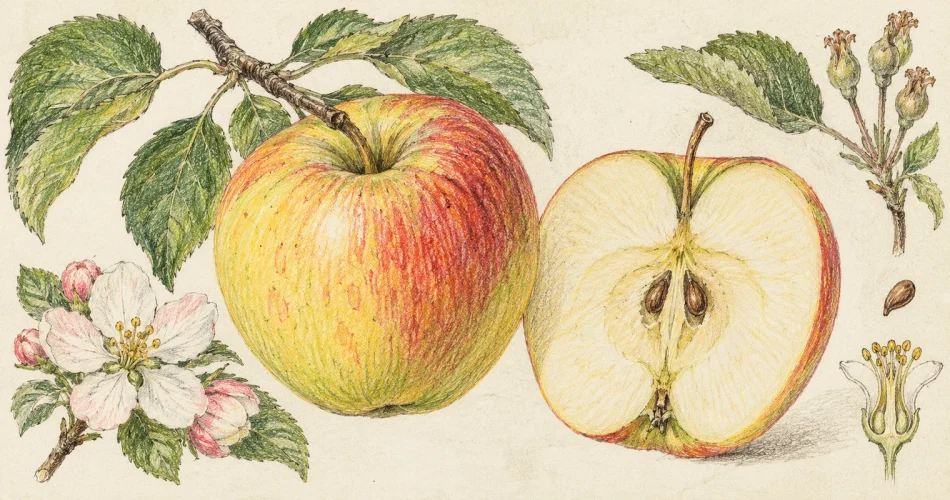
A strawberry left on the kitchen counter may spoil within days. An apple, stored under the right conditions, can remain edible for months.
Yet neither fruit stops living when it’s picked.
Inside an apple, millions of cells continue consuming oxygen, releasing carbon dioxide and using stored energy. Its connection to the tree is gone, but its metabolism carries on.
But here is the puzzle: two fruits can breathe at almost the same rate yet remain fresh for radically different lengths of time.
How fast does an apple breathe?
An apple has no lungs. Gases move through its skin, including tiny openings called lenticels, while living cells use oxygen to release energy from stored carbohydrates. Scientists call this cellular respiration.
They measure it in millilitres of carbon dioxide per kilogram of fruit per hour, written as mL CO₂/kg·h. If the rate is 20, a kilogram of fruit gives off 20 millilitres of CO₂ in an hour.
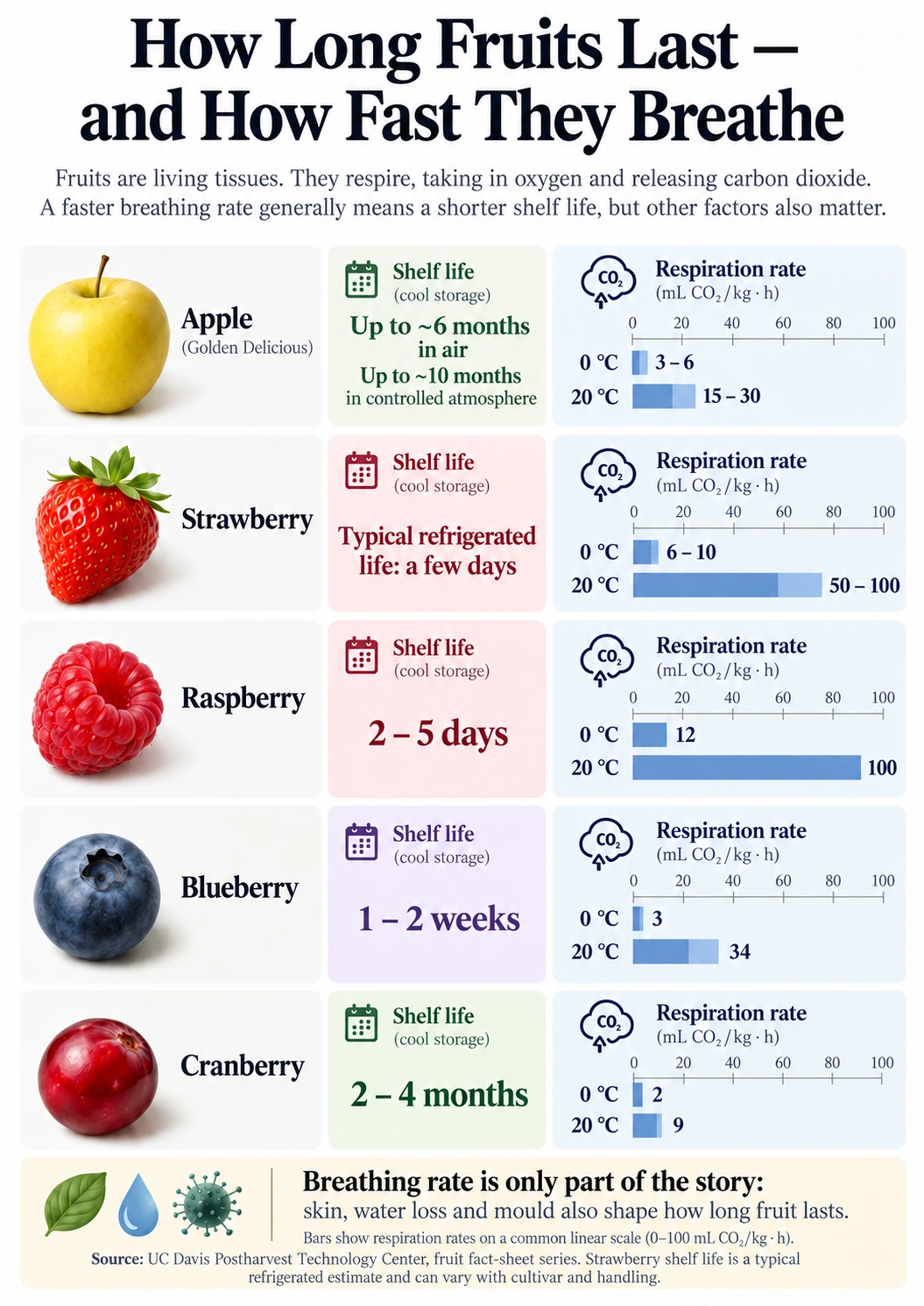
For Golden Delicious apples, UC Davis reports 3–6 mL/kg·h at 0°C and 15–30 at 20°C. Comparing the midpoints gives a fivefold increase. Riper apples generally respire faster, and rates vary between varieties.
At 20°C, strawberries release 50–100 mL/kg·h, more than three times the apple’s rate. Yet a higher respiration rate is not necessarily what ends their shelf life. UC Davis identifies postharvest disease, especially Botrytis grey mould, as the main cause of strawberry losses. Tissue damage, water loss and handling conditions matter too.
The blueberry puzzle: why breathing rate is not shelf life
Here is the most revealing comparison in the data. At 0°C, UC Davis reports that blueberries produce about 3 mL CO₂/kg·h, compared with 3–6 for Golden Delicious apples. Their respiration rates overlap, yet the same UC Davis fact-sheet series gives blueberries only 1–2 weeks of cold storage and apples up to six months in ordinary refrigerated air. These are guidance figures, not a controlled head-to-head experiment, but they make one point unmistakable: respiration rate alone cannot predict storage life across fruits.
Ripening stage is part of the difference. Apples intended for long storage are typically harvested physiologically mature but before the major ethylene-driven ripening surge. Ethylene is a plant hormone that helps coordinate ripening, softening and changes in aroma; cold and controlled atmospheres slow those processes. Berries, by contrast, are generally picked close to eating ripeness. There is an important exception to any tidy division: blueberries are also climacteric and respond to ethylene. They still do not keep like apples. So ethylene, too, is only one part of the answer. University of Maryland Extension explains the harvest-and-ethylene connection.
The fruit’s physical defences and its enemies matter. A protective cuticle, resistance to bruising, moisture loss, microbial decay, cultivar and harvest maturity can become the limiting factors even when respiration is slow. Strawberry losses, for example, are dominated by diseases such as grey mould, which can continue growing slowly at 0°C. This is why low respiration is a useful physiological measurement, but not a countdown clock for freshness. UC Davis: Strawberry.
The refrigerator before refrigerators
Long before mechanical refrigeration, growers stored late-season apples in cool cellars, slowing deterioration without stopping the fruit’s metabolism. For traditional household storage, the Royal Horticultural Society advises a cool, ventilated, dark place, with suitable humidity and temperatures around 4–7°C. Not all varieties keep equally well.
Commercial storage can delay ripening much more precisely. The 1999 UC Davis Golden Delicious fact sheet describes controlled atmospheres of 1–3% oxygen and 1.5–3% carbon dioxide, with storage potential of up to ten months versus about six months in refrigerated air. Those figures remain a useful reference, but they are not a complete description of today’s methods. The ethylene-action blocker 1-methylcyclopropene (1-MCP) is also used commercially to delay ripening; some facilities use dynamic controlled atmospheres that adjust oxygen in response to the fruit, sometimes near 0.5–0.6%. Both approaches need cultivar-specific management, since excessively low oxygen or unsuitable gas conditions can damage fruit. University of Maine on 1-MCP; 2021 dynamic-atmosphere study.
The apple is not holding its breath. Storage manages several processes at once: respiration, ethylene-driven ripening, water loss and the risk of deterioration.
Why did the apple become a symbol of health?

The earliest documented ancestor of An apple a day keeps the doctor away appeared in 1866, attributed to Pembrokeshire, Wales. A shorter version appeared in the South Wales Daily News on 18 February 1892. See the historical references.
Twentieth-century apple advertisers did not invent the saying. But why apples? The historical record offers a stronger direct clue than winter storage: writing in 1890, physician William Thomas Fernie discussed a bedtime version of the saying, linking it to apples’ supposed digestive and bowel effects. Those are historical beliefs, not modern clinical proof. A memorable rhyme and the everyday availability of apples are other possibilities. Winter storage may have contributed, but the cited nineteenth-century passages do not establish that link. We do not know which explanation gave rise to the proverb. Read the early quotations.
Did anyone actually test the proverb?
Yes, in a suitably playful 2015 JAMA Internal Medicine study comparing 753 adults who reported eating at least 149 g of whole apple in the previous day’s dietary recall with 7,646 others. At first, apple eaters appeared less likely to visit a doctor. After accounting for demographic and health-related differences, the association was no longer statistically significant.
There was a marginal association with using fewer prescription medicines, so the researchers offered an alternative: An apple a day keeps the pharmacist away. Published online on 30 March 2015, just before April Fool’s Day, the paper was accompanied by a tongue-in-cheek editor’s note, The Prescription Is Laughter. It was a real observational analysis. It was not evidence that apples caused people to need fewer doctors or medicines.
What an apple can actually do before lunch
The proverb does not tell us what an apple does to human health. A separate experiment offers a narrower, testable answer. In a 2009 crossover experiment, 58 adults were given peeled apple pieces, applesauce or apple juice before lunch. The preliminary portions were matched at 266 g and approximately 125 kcal; apple pieces, applesauce and juice with added pectin were also similar in fibre. Participants then ate as much lunch as they wanted.
Even adding fibre to juice did not reproduce the solid apple’s effect. Crucially, participants were paced to consume every starter over the same ten minutes; the result cannot simply be dismissed as the juice being drunk faster. Chewing, physical structure and differences in food volume remain plausible explanations, but this design cannot isolate which mattered most. This was one controlled meal, not proof of long-term weight loss.
A fruit that hasn’t finished living
The apple on your table might have been picked months ago, yet its cells are still using oxygen and releasing carbon dioxide. The surprising part is not that it breathes slowly. Blueberries can breathe just as slowly and still last only weeks. What keeps a stored apple marketable is a combination of harvest maturity, managed ripening, cold, carefully chosen atmospheres and protection against damage and decay.
The historical evidence does not tell us why the Welsh proverb singled out apples. Some nineteenth-century advocates talked about digestion; winter availability is another possibility. The biological puzzle and the proverb are related stories, not a demonstrated chain of cause and effect.
Your apple is still breathing. But breathing alone does not explain why it is still here.
Sources and how to read the figures
Respiration and storage: UC Davis, Golden Delicious; Strawberry; Bushberries; RHS storage advice; Maryland Extension on ripening and ethylene; Maine Extension on 1-MCP; DCA study (2021). History: Word Histories, archival references. Health: JAMA 2015 and Flood-Obbagy & Rolls 2009.
The graphic compares physiological measures, not nutrient value or human health outcomes. Storage spans refer to suitable conditions, not room-temperature shelf life.