In May 2025, a small patch of Texas held a vote. The question was whether to become a city. The result was 212 in favour and six against.
Only 283 people were eligible to vote. More than three in five worked for SpaceX, while the company and its employees owned 237 of the area’s 247 residential plots. The first mayor was a SpaceX vice-president. The new city was called Starbase. The election results, voter analysis and property figures are public.
Elon Musk had not declared independence from the United States. He did not need to. Starbase remained in Texas, but its residents had created a municipal government with powers that go beyond those of a private landowner.
What if a billionaire wanted to go further? Buy an island, set the taxes, write the commercial law, open a court, perhaps even declare a new country? Is money the obstacle, or something else?
The short answer: a billionaire can buy land and may be able to establish a city or negotiate an unusually autonomous jurisdiction. But buying an island does not buy sovereignty. The fascinating question is how far a private venture can go before the state, the investors and the people living there disagree about who is in charge.
You can buy an island. Do the laws come with it?
Suppose you buy every square metre of a privately owned island. The deeds are registered in your name. Could you now abolish income tax, issue passports and tell the nearest government to keep out?
No. A property deed transfers ownership, not legislative authority. The island remains within the country whose territory it forms. Its criminal law, courts and borders do not disappear with the sale.
You could negotiate with that government. It might create a special economic zone, delegate some administrative powers or allow a distinct system of commercial rules. Those arrangements can be extraordinarily far-reaching. But the source of their legal authority is still the existing state, not the purchase contract.
There is a further complication. Suppose a few families have lived on the island for generations and do not wish to sell. Does buying the rest give you authority over them? Keep that question in mind. It will turn up again in the most ambitious modern example.
Starbase: a company town without independence
SpaceX found a route that required no change to the American constitutional order. Acquire property, build a launch complex, attract employees and then use the ordinary legal process for creating a municipality. In Starbase, that process delivered a city in which the company’s interests were unusually influential. It did not deliver a privately owned government.
Before the rockets, Boca Chica was a small coastal community. In 2019, resident Maria Pointer told the Los Angeles Times she had expected to remain there for the rest of her life. SpaceX was buying houses as it expanded. She and her husband later moved away.
By the 2025 vote, the area had changed. More than three fifths of the 283 people eligible to vote worked for SpaceX, although that does not tell us how any individual voted. The three unopposed people elected to run the new city, mayor Bobby Peden and commissioners Jordan Buss and Jenna Petrzelka, were current or former SpaceX employees. The city now had public responsibilities of its own.
One practical prize was authority over access near the launch site. Under 2025 Texas legislation and a December 2025 standing order, Starbase can carry out specified temporary road and coastal closures for launches, subject to public notice and safety requirements. SpaceX already controlled its facilities. Municipal status gave the surrounding territory a different public framework.
Texas remained sovereign. But for a business that launches rockets, a municipality aligned with its operations may be more useful than a miniature independent republic. A flag is not what clears a road on launch day.
Próspera: a city selling different rules
For a bolder experiment, travel to Roatán, an island in Honduras. Here, Próspera offers something closer to the dream of a city whose laws can compete for residents and businesses.
An ABC News investigation reported roughly 200 permanent residents in August 2026. Rich Lee, an American entrepreneur working on human-enhancement technology, moved there partly for its regulatory freedom.
This is the attraction of the model: rather than move to a city and accept whatever rules it inherited, you choose a place partly because its rules are different. Yet that freedom has a second side, and it becomes apparent when you imagine buying a home there.
What if you own the house but lose permission to live in it?
Próspera’s published 2024 model residency agreement treats permission to live in the zone as distinct from ownership of property. During the first year, the residency permission can be revoked without stated cause, subject to at least 60 days’ notice.
If a resident has no other right to stay and cannot overturn a termination in court or arbitration, the agreement envisages denying access even to their own property and, conditionally, selling it to an eligible buyer. Net proceeds after expenses and debts would go to the former owner.
We do not know whether all residents signed this version, whether its provisions have been enforced or whether Honduran courts would uphold them. No eviction under these terms has been verified.
Owning property does not automatically confer residence rights anywhere. The harder question is what happens after someone has sunk their savings into a home or business. Choosing a jurisdiction is easier than leaving it.
So how does a city built around laws make money?
The rules are part of what is on sale. In tax guidance consulted on 27 October 2026, Próspera lists 1% of gross business income, 5% of personal income and 2.5% retail VAT. Its 1% land-value tax is currently suspended. These are the project’s published rates.
The model is straightforward: attractive rules draw firms and residents; developers sell or rent property; local businesses gain customers; the host country receives revenue. Demand might also increase land values.
According to Próspera’s FAQ, consulted on 27 October 2026, 12% of fiscal collections goes to Honduran public institutions, 44% to the zone and 44% to its general service provider. These are stated proportions, not audited flows.
Investors are betting that different laws will make property and businesses more attractive. Pronomos Capital lists Próspera among its investments, though its portfolio cannot tell us what any particular billionaire personally invested.
There is a fundamental commercial tension. A successful jurisdiction wants residents to trust that its rules will endure. Yet the organisations providing governance may also have financial incentives of their own. Who checks the rule-makers, and what happens if the country that authorised them wants its authority back?
Honduras changes course
Próspera was not set up outside Honduran law. It emerged under the country’s ZEDE legislation, which gave designated zones unusually broad regulatory autonomy. Honduras repealed the legislative framework in 2022. In 2024 its Supreme Court declared the underlying ZEDE regime unconstitutional. The consequences for existing agreements remain contested.
Companies linked to Próspera brought a claim in international investment arbitration. An initial demand of US$10.775 billion drew headlines. By October 2025, claimants sought restoration of their asserted rights or, alternatively, about US$1.63 billion. The figures are not additive; neither amount had been awarded by October 2026.
The investors argue that Honduras promised legal stability for decades and cannot simply discard those undertakings. Opponents challenge the legitimacy of the ZEDE framework itself. This is a disagreement about which promises count, who could make them, and who bears the loss when a government changes its mind.
Próspera Arbitration Center LLC is among the companies suing Honduras. It is also a default provider for certain private disputes in the zone, unless parties agree otherwise. The international case is heard by an independent ICSID tribunal, not by that centre. The dual role warrants scrutiny but does not itself establish bias.
A September 2026 disclosure seeks to cap certain legal-stability claims against a defined group of Próspera-related entities at US$100, subject to important exceptions and applicable law. We found no judgment enforcing that limit for any particular person. The contrast with the investors’ own claims is striking.
Meanwhile, just outside Próspera is Crawfish Rock, a community established long before the project. Venessa Cardenas Woods, whose family has lived there for generations, told ABC News that the project had brought jobs but also divided neighbours. Some welcome the opportunities. Others worry about what its expansion may mean.
In September 2026, the international tribunal allowed seven community representatives and several organisations to file written views, limited to 15 pages each. They did not become parties, gain general access to the case file or acquire the right to attend hearings. Those limits are set out in Procedural Order No. 8.
Here the voluntary-city idea meets the territory around it. The people who sign up may favour the special rules. Their neighbours did not necessarily get to choose. Who should have a say when privately backed governance has effects beyond the property line?
Behind the story: money, property rights and political influence
The broad argument above rests on documents that deserve closer reading. The numbers below describe different kinds of money, and the legal clauses describe possible contractual consequences, not confirmed court decisions or actual evictions. Expand this record to see what is established and what remains open.
1. The investor numbers are not one bank account
The 2022 SEC Form D/A for Honduras Próspera Inc. reported US$46.775 million in debt securities sold, but explicitly clarified that the amount represented commitments by US investors (13 investors). It is not an audited statement that the same sum arrived as cash or was spent on Roatán.
A different equity offering, amended in May 2026, reported US$32,276,999 sold against a US$66.3 million offering (one investor). Its earlier US$10 million figure was superseded by that amendment: it should not be added again. Nor should the two offerings simply be summed and presented as audited construction expenditure. Pronomos Capital is a publicly named investor, but Peter Thiel’s or Marc Andreessen’s exact personal exposure to Próspera cannot be calculated from those documents.
2. What happens when a resident loses their status?
The published August 2024 Agreement of Coexistence form distinguishes property ownership from a personal residency licence. Article VI §1(a) permits termination without cause during the first year on at least 60 days’ prior notice. Under §2(a–b), if a qualifying termination occurs and a resident fails to leave without prevailing in a court or arbitral challenge, the text envisages denial of access even to real estate the resident owns inside the zone. It also sets out a conditional property-transfer or sale procedure restricted to eligible buyers.
Crucially, the document says that net sale proceeds would be paid back to the former owner after applicable costs and outstanding obligations. It does not simply provide for confiscating a house. A challenge to the termination is contemplated. This is a published form: we have not established that every current resident signed it or that a Honduran court would enforce its more extensive powers. The 2024 constitutional ruling against the ZEDE framework makes the question of enforceability especially unsettled.
3. What does the US$100 liability clause cover?
A separate Legal Stability Disclosure and Disclaimer, updated 29 September 2026, §13(b), attempts to limit the aggregate liability of a defined group of entities to US$100 for claims concerning the matters described in that disclosure, to the extent applicable law permits. It expressly excludes obligations to return funds or property held for someone, recognises non-waivable rights, and preserves certain independent legal-stability agreements. The cap is not the price of a home, a universal cap on residents’ losses or an adjudicated limit that we know applies to any particular person.
The contrast remains striking: investors are seeking treaty-based remedies for a change in the legal regime, while the operator’s own disclosure allocates some of the risk of that instability to users. That is a documented difference in contractual positions, not proof that anyone has lost compensation.
4. Where the political pressure shows up
A US federal lobbying-disclosure aggregator records US$485,000 in reported lobbying fees across three firms representing Honduras Próspera Inc. for filings covering 2025 and the first three quarters of 2026: US$375,000 for 2025 and US$110,000 for 2026. Reported activities include contacts with Congress and federal offices about foreign relations, trade and investment. These are disclosed, lawful lobbying activities; their existence does not establish corruption or show that any government decision was bought.
What the documents cannot establish
These records do not reveal the project’s fully audited consolidated cash flows, the legal outcome of the pending investor-state case, the enforceability of individual residents’ agreements or how frequently the disputed contract provisions have been used. No original resident interviews were conducted for this documentary comparison. The evidence supports scrutiny of the incentives and remedies, not a declaration that the project or its participants acted unlawfully.
Requests for comment
Mike’s Balance contacted Próspera, SpaceX and the City of Starbase to invite comments on this article. As of 27 October 2026, no responses had been received. This is not evidence that any organisation declined to comment. We will review substantive responses and update the article where warranted.
Can you write a contract that outlives politics?
Perhaps the problem is simply that investors need better guarantees. A sufficiently clever agreement, lasting generations, ought to protect the rules against the next government. Disney tried something rather close to that in Florida.
For decades the Reedy Creek Improvement District exercised significant local-government powers around Walt Disney World. It managed roads and utilities, supplied fire services, levied taxes and issued debt. The district was created by Florida law, not by a Disney declaration of independence.
When Disney’s public opposition to a Florida education law led to a confrontation with Governor Ron DeSantis and state legislators, Florida changed the district’s governance arrangements. Before a new state-appointed board took control in 2023, the outgoing board approved agreements favourable to Disney.
One clause measured the agreement’s duration by an unlikely clock: 21 years after the death of the last surviving descendant of King Charles III who was alive when it was signed. British royal lives had become a way of marking time in a Florida development contract.
It did not settle the political fight. Under a March 2024 settlement, Disney accepted that the outgoing board’s agreements were invalid. The sides later reached new development arrangements. Legal ingenuity had not made the existing deal immune to politics.
Nor does a large cheque buy the necessary public permissions. California Forever, backed by Silicon Valley investors, spent around US$1 billion acquiring nearly 70,000 acres (28,000 hectares) for plans including a new city. In August 2026, Solano County supervisors voted 3–2 against endorsing a fast-track shipyard proposal. The proposal had the backing of Governor Gavin Newsom’s office and would have allowed reliance on a broad, 18-year-old environmental review rather than a new assessment specific to the shipyard. Opponents questioned the environmental scrutiny and the consultation process.
The prospective shipyard tenant, Saronic, had already chosen Brownsville, Texas, on 16 July 2026, six weeks before the California vote. In June, Cameron County, also home to Starbase, had approved four conditional 95% property-tax abatements for successive phases of Saronic’s project, each with its own ten-year incentive period. The records establish the incentives and the choice of location, not that the incentives alone caused it.
The California vote did not cancel the broader city plans, and California Forever was not seeking independence. But the comparison returns us to Starbase: land and money are only part of what a project needs. The decisions of public authorities, and the conditions they attach, can be equally decisive.
A company once came much closer to governing a country
None of this was invented in Silicon Valley. In the nineteenth century, a British company acquired governing powers in North Borneo, now largely part of the Malaysian state of Sabah. The arrangement went much further than modern municipal autonomy. And it raises a question that can be lost in the excitement of a new city: what if the governed refuse to recognise the governors?
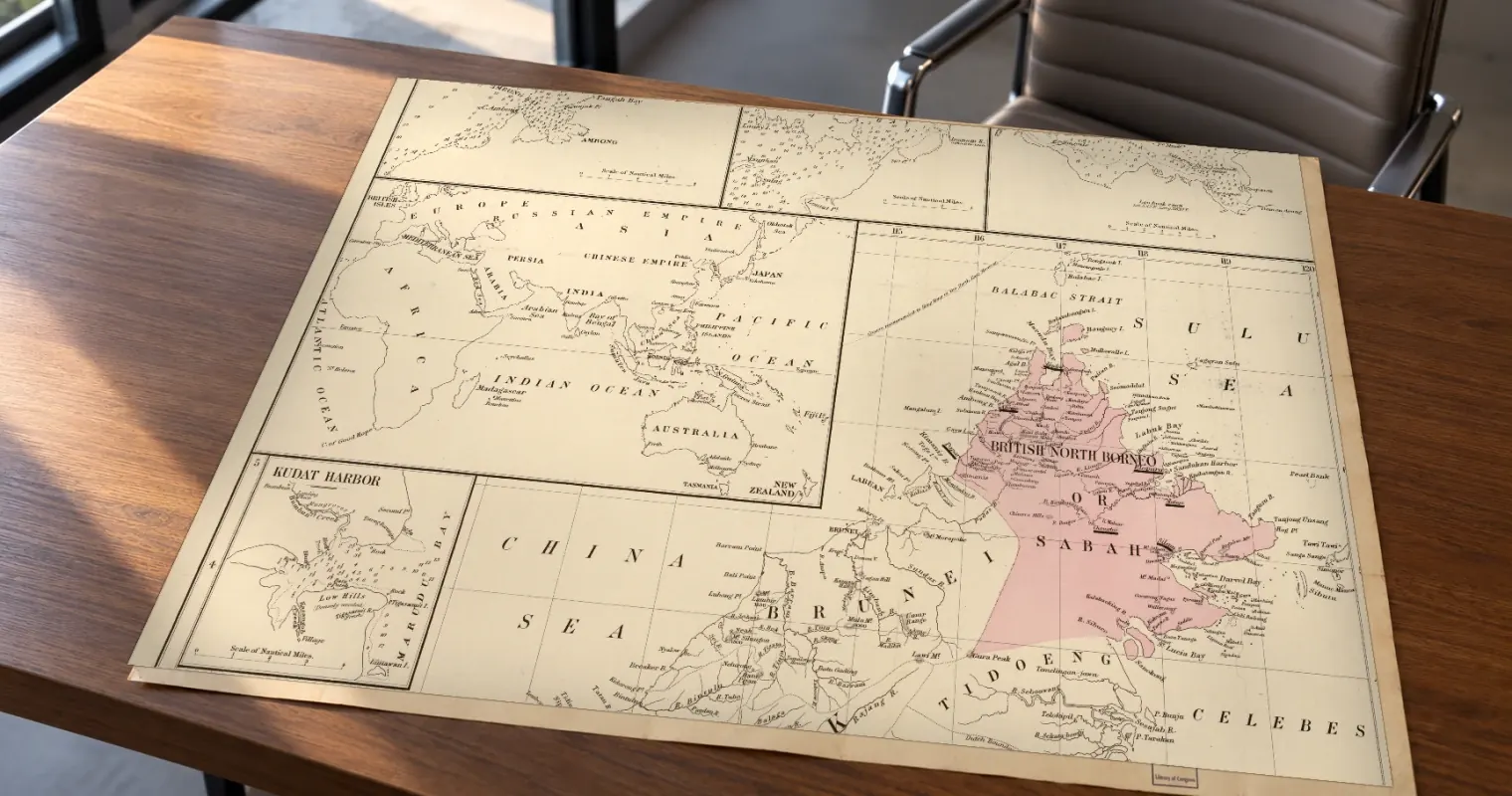
Businessman Alfred Dent and his associates negotiated grants from rulers of Brunei and Sulu in 1877 and 1878. In 1881, Queen Victoria granted the British North Borneo Company a royal charter.
Read the powers involved: the company could make laws, collect taxes, administer courts, issue money and maintain armed forces. One of the earlier commissions recited in the charter even claimed authority over life and death. A protectorate agreement signed in 1888 called the territory an “independent State”.
Yet Britain controlled foreign relations and provided external protection. The company was powerful enough to govern, but not independently sovereign in the modern sense.
It also had to earn revenue. When agriculture and mining disappointed investors, the company sold monopoly licences for gambling, spirits, opium and pawnbroking. A firm exercising governmental power charged other firms for permission to operate. The law itself had become a commercial asset.
The authority was resisted. Mat Salleh, a local leader, challenged company power amid disputes over taxation and territorial control. His followers attacked the company’s station on Gaya Island in 1897. After campaigns, negotiations and further fighting, he was killed during the siege of his stronghold in 1900. The charter’s power to raise forces was no longer an abstract clause.
War left North Borneo devastated. In 1946, the company negotiated the surrender of its governing rights to Britain. On 19 June, the House of Lords discussed the transfer. Shareholders were due to vote. But had the inhabitants been consulted? When pressed, Lord Winster answered in the parliamentary debate:
“I am not in a position to say upon what conversations or consultations the Chief Civil Affairs Officer in North Borneo has based his opinion.”
The official could offer an assurance on behalf of the population but could not explain how that assurance had been tested. The investors were being consulted; there was no comparable vote for the people governed.
North Borneo became a British Crown colony on 15 July 1946. The company received compensation for giving up the powers it had held. Shareholders had a formal say in the transaction; the inhabitants did not have an equivalent decision-making role.
The old concessions generated another astonishing dispute. In 2022 an arbitrator ordered Malaysia to pay US$14.92 billion to the heirs of the Sultan of Sulu. The Paris Court of Appeal annulled the award in December 2025. The multibillion-dollar figure is not an enforceable payout. But the dispute shows how contracts from an imperial age can outlive the political world that produced them.
Has anyone actually bought their way into statehood?
There are historical cases that make “never” too easy an answer. The princely house of Liechtenstein acquired Schellenberg in 1699 and Vaduz in 1712. Those territories became an imperial principality in 1719 and attained sovereignty in 1806. But the purchases alone did not create the sovereign state. Decisions by the political authorities of the day, and changes to Europe’s wider constitutional order, mattered.
From 1885 to 1908, Belgium’s King Leopold II personally ruled the Congo Free State, legally separate from Belgium. Its international recognition was real; so were forced labour, severe exploitation and mass violence. It demonstrates an historical form of personal rule over a recognised state, not a successful model for a modern investment project.
Neither example offers today’s island buyer a shortcut. International recognition is not a simple popularity contest, nor does it alone establish statehood. But a would-be state needs actual governing capacity and the ability to engage with the world. A property purchase cannot supply those by itself.
Perhaps independence is the wrong prize
Some of the most durable experiments in different laws have not pursued independence at all. The Dubai International Financial Centre has had its own commercial-law framework and courts since 2004. Abu Dhabi Global Market has operated an English-common-law court system since 2015. Neither is a sovereign country or a billionaire’s private kingdom. Both were created by governments that wanted to attract business.
That difference in incentives matters. Firms benefit from predictable rules and specialist courts. The host state benefits from investment, jobs and credibility. If it dismantles the system arbitrarily, it risks damaging its own strategy. The alignment of interests is a reason such arrangements may last, not a guarantee that they will.
So what can wealth actually secure? Land, if a willing seller exists. Municipal powers, through lawful political processes, as in Starbase. Special tax and commercial rules, if the state agrees, as it initially did with Próspera. Independent statehood is a fundamentally different matter, demanding much more than title deeds, an investor prospectus or a sympathetic minister.
The pattern is almost the reverse of what the romantic billionaire might expect. North Borneo had an army and taxes but depended on Britain. Disney had decades of special local governance but could not insulate it from Florida politics. Próspera is fighting to preserve its regulatory framework in arbitration. Dubai’s centres continue partly because their host governments have good reason to keep them.
The paradox: if you want to live under radically different rules, the most practical goal may be not freedom from an existing state, but a remarkably durable agreement with one. And the more you spend on buildings and infrastructure, the costlier it becomes to discover that agreement was less durable than you thought.
A billionaire may not need a country of their own. They need a jurisdiction whose rules will survive the next election. You cannot buy that with an island.
Sources & Documents
North Borneo
- British House of Lords debate, 19 June 1946, columns 1008–1010
- Royal Charter of the British North Borneo Company, 1881
- Protectorate Agreement, 1888
- North Borneo Cession Order, 1946
- Arbitration International (October 2026): Sulu heirs v Malaysia, 1878 concession and 2022 award
- Paris annulment of Sulu award, 9 December 2025
Historical context
- D. S. Ranjit Singh, The Mat Salleh Uprisings, 1895–1903, Sejarah
- Revenue Farming in British North Borneo, 1881–1941, Economic History Malaysia
- US State Department (1886): Leopold II and the separate Congo Free State
- AfricaMuseum: Congo Free State, forced labour and violence
- Liechtenstein Embassy: purchases of Vaduz and Schellenberg and later sovereignty
Starbase
- Los Angeles Times (2019): Boca Chica home buyouts
- Houston Chronicle (3 May 2025): residential ownership and incorporation
- The Texas Newsroom: the Starbase electorate
- Starbase municipal beach and road access notices
- Texas House Bill 5246 (2025)
- Texas Space Commission: standing closure order No. 2025-02, December 2025 (replacing September order)
California Forever: capital and local consent
- CalMatters, 19 August 2026: land acquisitions and fast-track lobbying
- CalMatters, 25 August 2026: Solano County supervisors’ 3–2 vote
- Cameron County, 16 July 2026: Saronic selects Brownsville for its shipyard
- Cameron County economic development register: Saronic’s four phased tax-abatement agreements
Disney
- Florida House Bill 9-B (2023)
- Central Florida Tourism Oversight District: 2024 development agreement
Próspera and Honduras
- Próspera: tax overview, including suspended land-value tax (consulted 27 October 2026)
- Próspera FAQ: stated 12/44/44 fiscal distribution (consulted 27 October 2026)
- Próspera: residency agreement and default dispute-resolution provider (consulted 27 October 2026)
- ABC News Australia investigation, 22 August 2026
- Honduran Supreme Court: the RED model-city law and 2012 constitutional ruling (historical review)
- RED to ZEDE legislative sequence (Charter Cities Institute)
- ICSID case ARB/23/2
- Próspera Arbitration Center: services
- Procedural Order No. 8 (9 September 2026)
- Próspera legal disclosure (29 September 2026)
Further documentary findings: capital, residency and lobbying
- SEC Form D/A, 2 September 2022, debt commitments
- SEC Form D/A, 12 May 2026, equity offering
- Próspera’s 2024 signed resident agreement, Article VI
- Próspera’s 29 September 2026 legal-stability disclosure, section 13(b)
- US federal lobbying-disclosure aggregation, 2025–2026
Political bargaining and economic zones
- Vernon’s obsolescing bargain and later empirical critiques (Cambridge University Press)
- UNCTAD World Investment Report 2019, special economic zones
- Pronomos Capital: investment approach
Disney, new cities and investor guarantees
- Disney’s 2023 royal-lives covenant, contemporaneous reporting
- AP: Disney–Florida settlement, March 2024
- Pronomos Capital: selected investments
- WIRED: Freedom Cities proposals and lobbying
- Próspera’s own legal-stability claims (disputed)
Cases of enduring autonomy
- DIFC Courts: legal framework, 2004
- Abu Dhabi Global Market: English common law and courts
- Liechtenstein’s Constitution of 2003
- The Princely House: 2003 constitutional changes and referendum rights
- Prince Hans-Adam II, The State in the Third Millennium (publisher)
Editorial name note: ABC News uses “Vanessa Cardenas”, while ICSID Procedural Order No. 8 identifies the Crawfish Rock representative as “Venessa Cardenas Woods”. The article follows the tribunal document.